




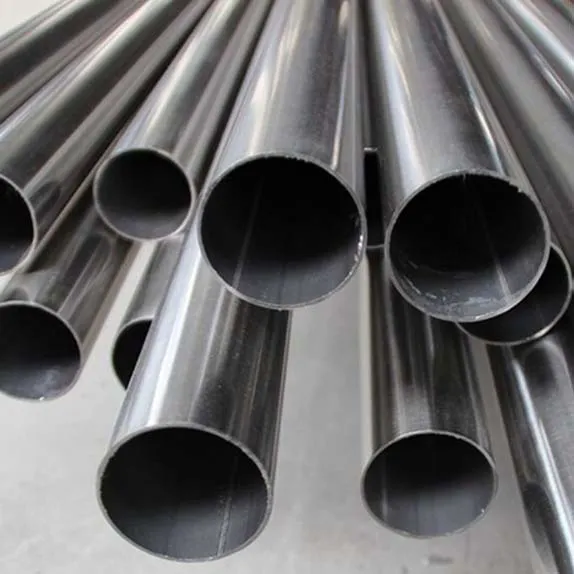
Stainless Steel Seamless Pipe Specifications
Seamless pipe is made by piercing a solid billet, so there is no weld seam anywhere in the wall. That is what lets it carry higher pressure than welded pipe of the same size.
| Parameter | Specification |
|---|---|
| Manufacturing Standard | ASTM A312 / ASME SA-312 |
| Applicable Grades | 304 / 304L, 316 / 316L, 321, 347, 310S, 904L |
| Size Range | 1/8" to 36" NPS |
| Schedule Range | SCH 5S to 160; XXS up to NPS 12 |
| Material Category | Austenitic and Duplex Stainless Steel |
How Seamless Stainless Steel Pipe Is Made
A seamless pipe starts as a solid round billet. There is no strip, no seam and no weld at any stage. That is the whole reason it holds more pressure than a welded pipe of the same diameter and wall.
01. Heating and piercing. The billet is heated until it is plastic, then rotary pierced over a conical plug. The plug opens a hole down the centre and the billet becomes a thick-walled hollow.
02. Elongation. The hollow is rolled out over a mandrel or plug mill. This thins the wall and draws out the length while holding the bore round.
03. Sizing and cold drawing. Hot-finished pipe is sized to its final outside diameter. Where a tighter tolerance or a better surface is wanted, the pipe is cold drawn through a die over a plug. Cold drawing also work-hardens the material, which is why the next stage matters.
04. Annealing and finishing. Solution annealing takes the cold work back out and puts the carbides back into solution. ASTM A312 requires austenitic pipe to be heated to at least 1,040 °C and then quenched or rapidly cooled. The pipe is then pickled, straightened, cut to length and tested before it is marked.
Size and Weight Chart
The chart below gives outside diameter, wall thickness and weight per metre for the three most commonly ordered schedules. Weights are theoretical, worked out as (OD − wall) × wall × π × density at 8.0 g/cm³.
| NPS | OD (mm) | Sch 10s WT (mm) / Wt (kg/m) | Sch 40s WT (mm) / Wt (kg/m) | Sch 80s WT (mm) / Wt (kg/m) |
|---|---|---|---|---|
| 1/2" | 21.3 | 2.11 / 1.02 | 2.77 / 1.29 | 3.73 / 1.65 |
| 3/4" | 26.7 | 2.11 / 1.30 | 2.87 / 1.72 | 3.91 / 2.24 |
| 1" | 33.4 | 2.77 / 2.13 | 3.38 / 2.55 | 4.55 / 3.30 |
| 1-1/2" | 48.3 | 2.77 / 3.17 | 3.68 / 4.13 | 5.08 / 5.52 |
| 2" | 60.3 | 2.77 / 4.01 | 3.91 / 5.54 | 5.54 / 7.62 |
| 3" | 88.9 | 3.05 / 6.58 | 5.49 / 11.51 | 7.62 / 15.57 |
| 4" | 114.3 | 3.05 / 8.53 | 6.02 / 16.38 | 8.56 / 22.75 |
| 6" | 168.3 | 3.40 / 14.09 | 7.11 / 28.80 | 10.97 / 43.38 |
| 8" | 219.1 | 3.76 / 20.35 | 8.18 / 43.36 | 12.70 / 65.88 |
| 10" | 273.1 | 4.19 / 28.32 | 9.27 / 61.47 | 12.70 / 83.12 |
| 12" | 323.8 | 4.57 / 36.67 | 9.53 / 75.27 | 12.70 / 99.30 |
Dimensional Tolerances
ASTM A312 specifies the following dimensional tolerances for stainless steel seamless pipes. These values apply to hot-finished and cold-drawn products. Cold-drawn pipes generally achieve tighter tolerances than hot-finished products.
| Parameter | Tolerance |
|---|---|
| Outside Diameter (NPS 1/8" to 1-1/2") | +0.4 mm / -0.8 mm |
| Outside Diameter (NPS 2" to 12") | +/- 0.8 mm to NPS 4"; +1.6 mm / -0.8 mm over NPS 4" to 8"; +2.4 mm / -0.8 mm over NPS 8" to 12" |
| Wall Thickness | -12.5% / +20.0% (NPS 1/8" to 2-1/2"); -12.5% / +22.5% or +15.0% by t/D ratio (NPS 3" to 18") |
| Length (standard 6 m) | +6 mm / -0 mm |
Surface Finish Options for Seamless SS Pipe
Finish is ordered separately from grade and schedule, and it decides how the bore behaves in service. A smoother surface holds less deposit, cleans more easily, and gives pitting fewer places to start.
| Finish | How it is produced | Where it is specified |
|---|---|---|
| Annealed & Pickled (AP) | Solution annealed, then acid pickled to strip the heat scale | The default for process and structural piping |
| Bright Annealed (BA) | Annealed in a controlled atmosphere so no scale forms, leaving a bright surface | Where a smooth, reflective bore is wanted without mechanical polishing |
| Polished | Mechanically abraded, commonly to 180 or 320 grit | Visible installations, dairy and food lines, architectural work |
| Electropolished (EP) | Electrochemically removes the outermost layer, rounding off the peaks left by grinding | Pharmaceutical, semiconductor and high-purity service |
Surface roughness (Ra) is quoted against your specification at enquiry, because it depends on the grade, the wall and the finishing route taken. Tell us the Ra you need and we will confirm what the mill can hold.
Stainless Seamless Pipe Price
Pricing depends on grade, size (OD and wall thickness), schedule, order quantity, and prevailing raw material costs. SS 304 is generally 15 to 20% less expensive than SS 316 because it contains no molybdenum. Duplex 2205 carries a further premium due to its specialised alloy content.
Factors that influence the final price per metre include:
- Grade selection (304 vs 316 vs 904L vs duplex 2205)
- Wall thickness and schedule (heavier schedules cost more per unit length)
- Order quantity (bulk orders attract volume discounts)
- Surface finish (mill finish, pickled, or electropolished)
- Testing requirements (hydrostatic test, PMI, ultrasonic examination)
- Delivery terms (FOB, CIF, CFR)
For current pricing on any grade or size, request a quote from our sales team. We provide transparent pricing with no hidden charges.
Stainless Steel Seamless Pipe Applicable Standards & Grades
Applicable Standards
The pipes conform to multiple national and international standards depending on the end-use application and export destination. The table below lists the primary standards that comply with our pipes.
| Standard | Description | Applicable Grades |
|---|---|---|
| ASTM A312 / ASME SA-312 | Seamless and welded austenitic SS pipes | 304, 304L, 316, 316L, 321, 347, 310S |
| ASTM A376 / ASME SA-376 | Seamless austenitic SS pipe for high-temperature central-station service | 304H, 316H, 321H, 347H |
| ASTM A790 / ASME SA-790 | Seamless ferritic/austenitic (duplex) SS pipe | 2205, 2507 |
Grades
The most commonly specified grades are 304/304L for general service and 316/316L for marine and chemical environments. High-temperature applications depend on 321 and 347. Severe-corrosion environments require 904L or duplex 2205. This section covers austenitic and duplex grade families in detail.
Austenitic Stainless Steel Seamless Pipe Grades
304
304 is the most widely preferred austenitic grade. It contains 18% chromium and 8% nickel (the classic 18/8 composition). This grade provides reliable general-purpose corrosion resistance for food processing, architectural trim, and chemical containment.
304L
304L has a reduced carbon content of 0.035% max, which prevents carbide precipitation during welding. Choose 304L when the pipe will be welded and post-weld heat treatment isn't feasible.
316 / 316L
316 contains 2 to 3% molybdenum, which gives it better resistance to chloride pitting and crevice corrosion compared to 304. Marine environments, coastal chemical plants, and pharmaceutical clean-rooms commonly rely on this grade. 316 costs approximately 15 to 20% more than 304 due to higher alloy content, but the cost is justified wherever chlorides are present. The low-carbon 316L variant follows the same logic as 304L for welded constructions.
321
321 is stabilised with titanium to resist intergranular corrosion at temperatures between 425 and 815°C. It's used in exhaust manifolds, expansion bellows, and refinery transfer lines.
347
347 uses niobium (columbium) stabilisation instead of titanium and offers better creep strength above 540°C. Petrochemical furnace tubing and reactor piping prefer 347 for this reason.
Duplex Stainless Steel Seamless Pipe Grades
2205 (UNS S31803)
Grade 2205 contains 22% chromium, 5% nickel, and 3% molybdenum. Its yield strength of 65 ksi (450 MPa) allows engineers to specify thinner wall sections. This leads to a reduction in weight and material cost. Offshore oil and gas platforms, desalination plants, and chemical tankers frequently specify 2205 seamless pipe per ASTM A790.
Corrosion Resistance Compared
PREN, the pitting resistance equivalent number, ranks how well a grade resists pitting in chlorides. It is worked out from the chemistry as %Cr + 3.3 × %Mo + 16 × %N. The figures below use typical mid-range composition; a mill certificate for any given heat will sit either side of them.
| Grade | Chromium | Molybdenum | Nitrogen | PREN (typical) |
|---|---|---|---|---|
| 304 / 304L | 18.0–20.0% | — | — | 19 |
| 321 | 17.0–19.0% | — | — | 18 |
| 347 | 17.0–19.0% | — | — | 18 |
| 316 / 316L | 16.0–18.0% | 2.00–3.00% | — | 25 |
| 310S | 24.0–26.0% | — | — | 25 |
| 2205 duplex | 21.0–23.0% | 2.50–3.50% | 0.08–0.20% | 34 |
| 904L | 19.0–23.0% | 4.00–5.00% | 0.10% max | 36 |
PREN compares one property only. It says nothing about the copper in 904L, which is what handles sulphuric acid, and nothing about the chromium in 310S, which is there for oxidation resistance at temperature rather than for chlorides. Use it to rank grades, not to design with.
Industrial Applications of Seamless Piping
Seamless piping serves four major industry sectors where corrosion resistance, hygiene, and pressure integrity are important.
Oil & Gas Industry
SS seamless pipes carry fluids across upstream, midstream, and downstream operations. Subsea flowlines, topside process piping, and downhole tubing all rely on seamless construction for pressure safety.
Chemical & Petrochemical Processing
Grade 904L resists sulphuric acid concentrations up to 40% at elevated temperatures, while 321 and 347 resist sensitisation in high-temperature reactor circuits.
Food, Beverage & Pharmaceutical
304L and 316L with electropolished internal surfaces are the most common selections for CIP (clean-in-place) systems and purified water loops.
Power Generation & Water Treatment
Power plants use these pipes in boiler superheater circuits, condenser tubing, and steam transfer lines operating at temperatures above 540 degrees Celsius.
Seamless vs Welded Stainless Steel Pipes
Seamless stainless steel pipes have no longitudinal weld seam, which provides a uniform grain structure and consistent wall thickness around the full circumference. This makes them the preferred choice for high-pressure, high-temperature, and safety-critical piping systems.
| Property | Seamless Pipe | Welded Pipe |
|---|---|---|
| Weld Seam | None | Longitudinal or spiral |
| Pressure Rating | Higher (no weak point) | Lower (limited by weld integrity) |
| Wall Uniformity | Very good | Good (minor variation at weld) |
| Surface Finish | Consistent | May need weld bead removal |
| Size Range | Typically up to 24" NPS; larger made to order | Available in larger diameters |
| Cost | Higher | Lower for equivalent size |
| Lead Time | Longer for large sizes | Shorter, widely stocked |
Welded stainless steel pipes are a practical alternative for low-pressure structural and fluid-transfer work, where cost matters more than pressure integrity. For critical process piping, boiler tubing, and subsea lines, seamless remains the industry standard.
Shipping & Packaging
 Heavy-Duty Wooden Box Packing
Stainless seamless pipe ships in many grades at once, so bundles are made up grade by grade and marked. Caps keep the bores clean.
- Heavy-duty wooden boxes or strapped bundles, with moisture barrier lining
- LLDPE stretch film wrapping on all bundles
- Plastic end caps on threaded and plain-end pipes
- Silica gel desiccants to minimise moisture exposure
- ISPM-15 compliant wooden packaging for export
 Pipe Bundle Yard Staging
 Container End-Cap Protection
 Wrapped Export-Ready Bundles
We Export Worldwide
Sachiya Steel International supplies stainless steel products to major industrial markets across North America, Europe, the Middle East, Asia and Africa with export-ready documentation and logistics support.
 USA
 Canada
 Germany
 UK
 Italy
 France
 Australia
 South Korea
 Indonesia
 Vietnam
 Singapore
 Malaysia
 Taiwan
 UAE
 Saudi Arabia
 Qatar
 Oman
 South Africa
 Nigeria
 Egypt
