




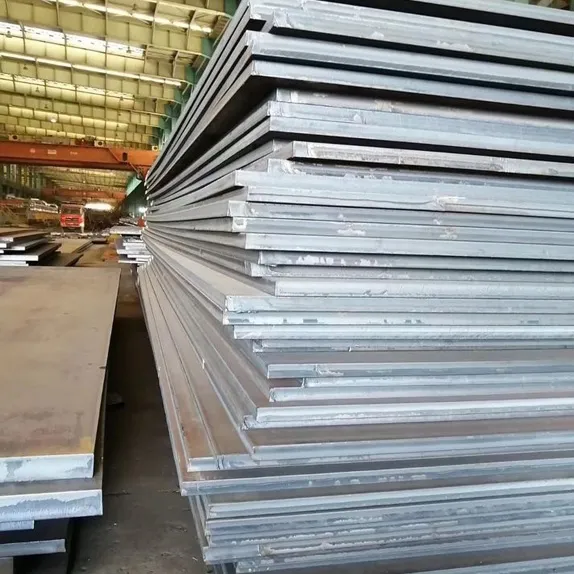
Specifications of ASTM A387 Gr.9 Plates
The ASTM A387 Gr.9 Plates specifications, including size, surface finish and forms, are listed in the table below.
| Parameter | Specification |
|---|---|
| Standards | ASTM A387 / ASME SA387 |
| Size Range | Width: 1000 mm to 3000 mm |
| Wall Thickness | 6 mm to 150 mm (can be customised as per requirement) |
| Length | Up to 18,000 mm (standard and cut-to-length plates available) |
| End Type | Mill Edge / Slit Edge |
| Surface Finish | Hot Rolled (HR), Shot Blasted, Pickled, Coated (Anti-rust oil / Painted) |
| Form | Plates, Sheets, Flat Plates, Cut Pieces |
Available Sizes of ASTM A387 Gr.9 Plates
The available sizes of ASTM A387 Gr.9 Plates are specified in the table given below.
| Parameter | Specification |
|---|---|
| Thickness Range | 6 mm to 150 mm |
| Width | Up to 3000 mm |
| Length | Up to 12000 mm |
| Custom Sizes | Available on request (cut-to-size plates) |
| Standard Availability | Standard mill sizes stocked |
| Non-Standard Sizes | Can be sourced directly from mills as per project requirements |
| Minimum Order Quantity | Varies based on thickness and size |
| Stock Availability | Available on request (contact supplier for current stock details) |
ASTM A387 Gr.9 Plate Price
ASTM A387 Grade 9 plates usually cost ₹125–₹695 per kg in India and $0.54–$1.32 per kg in the US. The exact price depends on the plate size (thickness, width, length), the quantity ordered, the class, and current market rates. Because Gr.9 is a high‑chromium Cr-Mo alloy, its plates are more expensive than lower‑chromium grades like ASTM A387 Gr.11 plate and Gr.22 plate.
Plate thickness is the single largest factor affecting per-kilogram cost; thicker plates require longer mill rolling cycles. Class 2 plates can be slightly more expensive than Class 1 because they need extra heat treatment to reach higher strength levels. Contact Sachiya Steel International for current pricing, bulk discounts, and availability from our ready stock of ASTM A387 Gr.9 plates.
ASTM A387 Gr.9 Plate Chemical Composition
This table shows the allowable chemical ranges for ASTM A387 Grade 9 plates. Its 9Cr‑1Mo chemistry provides strong resistance to high‑temperature corrosion. Around 8–10% chromium builds a protective oxide against sulfur attack, while 0.90–1.10% molybdenum increases high‑temperature strength and creep resistance.
| Element | Heat Analysis (%) | Product Analysis (%) |
|---|---|---|
| Carbon (C) | 0.15 max | 0.15 max |
| Manganese (Mn) | 0.30 – 0.60 | 0.25 – 0.66 |
| Phosphorus (P) | 0.030 max | 0.030 max |
| Sulfur (S) | 0.030 max | 0.030 max |
| Silicon (Si) | 1.00 max | 1.05 max |
| Chromium (Cr) | 8.00 – 10.00 | 8.00 – 10.50 |
| Molybdenum (Mo) | 0.90 – 1.10 | 0.85 – 1.15 |
ASTM A387 Gr.9 Plate Mechanical Properties
ASTM A387 Grade 9 plates are available in two classes. Class 1 has a minimum tensile strength of 415 MPa (60 ksi), which is suitable for medium-duty use. Class 2 offers higher tensile and yield strength for more demanding pressure vessel designs. The two classes allow engineers to select the right strength level for their design pressure and temperature.
Class 1 Mechanical Properties
The mechanical properties of ASTM A387 Gr.9 Plate Class 1 are listed in the table given below.
| Parameter | Specification |
|---|---|
| Tensile Strength | 415 – 585 MPa (60 – 85 ksi) |
| Yield Strength | ≥ 205 MPa (30 ksi) |
| Elongation | ≥ 22% (in 200 mm gauge length) |
Class 2 Mechanical Properties
The mechanical properties of ASTM A387 Gr.9 Plate Class 2 are listed in the table given below.
| Parameter | Specification |
|---|---|
| Tensile Strength | 515 – 690 MPa (75 – 100 ksi) |
| Yield Strength | ≥ 310 MPa (45 ksi) |
| Elongation | ≥ 18% (in 200 mm gauge length) |
ASTM A387 Gr.9 Plate Equivalent Designations
International Designation equivalent to ASTM A387 Gr. 9 Plate, including UNS number and Werkstoff Nr., is listed in the table below.
| Standard | Designation |
|---|---|
| UNS | K90941 |
| EN 10028-2 | X12CrMo9-1 |
| W.Nr. | 1.7386 |
ASTM A387 Gr.9 Plate Industrial Applications
ASTM A387 Grade 9 plates are used in high-temperature industrial applications. Three primary industries account for the majority of demand for these chrome-moly plates.
Petroleum Refining & Petrochemical Industry
A387 Grade 9 steel plates serve in hydroprocessing reactors, hydrotreating units, and catalytic reforming equipment for high-temperature pressure service.
Power Generation
Power plants use SA-387 Grade 9 plates in high-temperature parts such as superheaters, heat recovery units, and boiler tanks.
Chemical Processing
Chemical plants use Cr-Mo Gr.9 alloy steel plates to build reactors and other high-temperature vessels because they help keep the equipment strong and safe.
ASTM A387 Gr.9 vs. Other A387 Grades
ASTM A387 Grade 9 has superior high-temperature strength and corrosion resistance compared to other grades. This makes it ideal for demanding applications.
| Property / Feature | Grade 9 (9Cr-1Mo) | Grade 11 (1.25Cr-0.5Mo) | Grade 22 (2.25Cr-1Mo) |
|---|---|---|---|
| Chromium Content | ~9.0% | ~1.25% | ~2.25% |
| Molybdenum Content | ~1.0% | ~0.5% | ~1.0% |
| Oxidation Resistance | Excellent (highest among these) | Moderate | Good |
| Sulfidation Resistance | Excellent | Moderate | Good |
| High-Temperature Strength | Excellent | Moderate | Good |
| Creep Resistance | Excellent | Moderate | Good |
| Corrosion Resistance | Very High | Moderate | Good |
| Typical Service Temperature | Up to ~650°C | Up to ~540°C | Up to ~600°C |
| Weldability | Moderate (requires control) | Good | Good |
| Cost | Highest | Lowest | Medium |
| Typical Applications | High-temp reactors, power plants, petrochemical units | Boilers, pressure vessels | Refineries, heat exchangers |
ASTM A387 Gr.9 vs. Gr.91 (9Cr-1Mo-V)
ASTM A387 Grade 9 and Grade 91 are similar, but Grade 91 has higher creep strength for high‑temperature use.
| Property / Feature | Grade 9 (9Cr-1Mo) | Grade 91 (Modified 9Cr-1Mo) |
|---|---|---|
| Base Composition | 9Cr – 1Mo | 9Cr – 1Mo |
| Alloying Additions | None (standard composition) | Vanadium (0.18–0.25%), Niobium (0.06–0.10%), Nitrogen |
| Microstructure Strengthening | Solid solution strengthening | Carbide & carbonitride precipitation strengthening |
| Creep Strength | Good | Excellent (significantly higher) |
| Allowable Stress (>540°C) | Lower | Higher |
| Maximum Service Temperature | ~650°C | ~650°C+ (better performance at elevated temps) |
| Oxidation Resistance | Excellent | Excellent |
| Weldability | Moderate | More complex (requires strict PWHT control) |
| Heat Treatment | Normalizing & tempering | Mandatory controlled normalising & tempering |
| UNS Designation | K90941 | K91560 |
| ASME Designation | SA387 Grade 9 | SA387 Grade 91 |
| Substitutability | Not interchangeable | Not interchangeable |
| Typical Applications | Pressure vessels, reactors | Power plants, superheaters, and high-pressure piping |
| Cost | Lower | Higher |
Shipping & Packaging
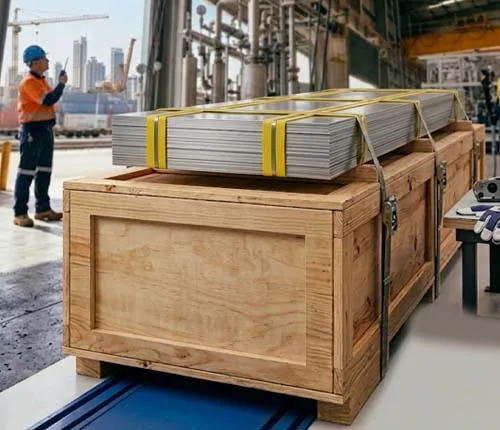 Heavy-duty wooden boxes Packing
We strictly follow seaworthy export handling standards to protect ASTM A387 Gr.9 Plates from transit damage, moisture ingress, and surface contamination during long-distance dispatch.
- Heavy-duty wooden boxes with moisture barrier lining
- HDPE stretch film wrapping on all bundles
- Plastic end caps on threaded and plain-end plate
- Silica gel desiccants to minimize moisture exposure
- ISPM-15 fumigated wooden packaging for export
 Plate Bundle Yard
Staging
Plate Bundle Yard
Staging
 Plate Bundle Edge Protection
 Wrapped Export-Ready
Bundles
Wrapped Export-Ready
Bundles
We Export Worldwide
Sachiya Steel International supplies Alloy steel products to major industrial markets across North America, Europe, the Middle East, Asia and Africa with export-ready documentation and logistics support.
 USA
USA Canada
 Germany
 UK
UK Italy
Italy France
 Australia
 South Korea
 Indonesia
 Vietnam
 Singapore
 Malaysia
 Taiwan
 UAE
UAE Saudi Arabia
 Qatar
Qatar Oman
Oman
 South Africa
 Nigeria
 Egypt
Egypt