




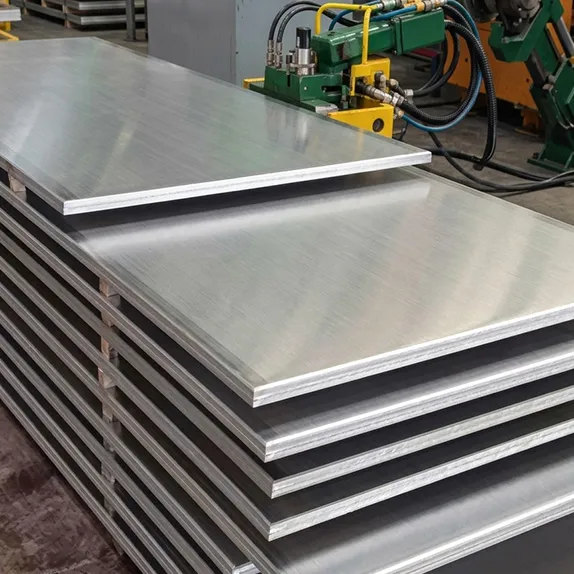
Specifications of Stainless Steel 316 Plates
SS 316 plate specifications, including standard, dimensions, forms, finishes, and more, are covered in the table below.
| Parameter | Specification |
|---|---|
| Standard | ASTM A240 / ASME SA240 |
| Thickness Range | 3 mm to 100 mm (custom sizes available) |
| Width Range | 1000 mm to 2500 mm |
| Length Range | 2000 mm to 6000 mm (or as required) |
| Form | Plates, Sheets, Coils |
| Finish | Hot Rolled Plate (HR), Cold Rolled (CR), 2B, No.1, No.4, Mirror Finish |
| Edge Condition | Mill Edge (ME), Slit Edge (SE) |
Available Sizes of Stainless Steel 316 Plates
Stainless Steel 316 plates are available in many sizes to meet different fabrication and project requirements.
| Parameter | Specification |
|---|---|
| Thickness Range | 3/16” (4.76 mm) to 3” (76.2 mm) and above |
| Standard Widths | 48” (1219 mm), 60” (1524 mm), 72” (1829 mm), 96” (2438 mm) |
| Length Range | 96” to 240” |
| Wide Plates | Up to 2000 mm (78.74”) width available |
Standard Plate Dimensions
Standard plate dimensions follow commonly used thicknesses and gauge equivalents, ensuring compatibility with industry fabrication and design standards.
| Category | Sizes / Range |
|---|---|
| Thickness (Inches) | 3/16”, 1/4”, 5/16”, 3/8”, 1/2”, 5/8”, 3/4”, 1”, 1-1/4”, 1-1/2”, 2”, 2-1/2”, 3” |
| Gauge Thickness | 20 GA (0.036”), 18 GA (0.048”), 16 GA (0.060”), 14 GA (0.075”) |
| Standard Widths | 48” (1219 mm), 60” (1524 mm), 72” (1829 mm), 96” (2438 mm) |
Custom Cut-to-Size Plates
Stainless steel plate cut to size is available with a tolerance of ±1/16”. We provide custom dimensions as per client specifications, reducing material waste and on-site fabrication time.
Stainless Steel 316 Plate Finishes
SS 316 plates are available in 4 standard surface finishes:
- Hot Rolled Annealed & Pickled (HRAP)
- 2B mill finish
- #4 brushed polish
- #8 mirror finish
Stainless Steel 316 Plate Price
SS 316 plate prices in India start from roughly Rs. 240 and go up to 320 per kg or $1.80 to $3.00+ per kg, depending on thickness, finish, quantity, and market conditions. International prices vary with the nickel and molybdenum rates, order quantity, and specification (standard ASTM A240 vs aerospace AMS 5524). Contact Sachiya Steel International for a current quote based on your dimensions and quantity.
Chemical Composition of Stainless Steel 316 Plates
ASTM A240 Type 316 plates contain the following elemental composition per ASME SA-240. The 2.00–3.00% molybdenum content distinguishes this alloy from 304 and provides superior chloride pitting resistance.
Mechanical Properties of Stainless Steel 316 Plates
ASTM A240 Type 316 plates deliver a minimum tensile strength of 75 ksi (515 MPa), yield strength of 30 ksi (205 MPa), and elongation of 35%.
| Property | Value |
|---|---|
| Tensile Strength (min) | 75 ksi / 515 MPa |
| Yield Strength, 0.2% Offset (min) | 30 ksi / 205 MPa |
| Elongation (min) | 35% |
Equivalent Grades of Stainless Steel 316 Plates
International equivalents across various regions, including EN, UNS, JIS, and more, for Grade 316 plates are listed below.
| Standard | Designation |
|---|---|
| UNS | S31600 |
| EN 10088 | 1.4401 / X5CrNiMo17-12-2 |
| JIS G 4305 | SUS 316 |
| GB/T 20878 | 06Cr17Ni12Mo2 |
| GOST 5632 | 08Kh17N13M2 |
| AFNOR | Z7CND17-11-02 |
Stainless Steel 316 Plate Industrial Applications
316 SS plates serve 4 primary industrial sectors. The 2.00–3.00% molybdenum content provides performance in chloride-rich and acidic conditions that 304 plates cannot match.
Marine and Offshore
Marine-grade stainless steel 316 plates are used in offshore platform decking, shipboard fittings, and desalination plant components for their long-term stability in high-chloride atmospheres.
Chemical and Petrochemical Processing
316 stainless steel plates are used in chemical plants in reactor vessels, heat exchangers, and storage tanks. It handles sulphuric acid, acetic acid, and phosphoric acid at moderate concentrations and temperatures.
Food, Beverage, and Pharmaceutical
These plates are used to make sanitary processing equipment, mixing vessels, and cleanroom wall panels.
Architectural and Structural
316 plates are used in exterior cladding panels, structural columns in coastal buildings, and roofing systems in industrial zones.
Stainless Steel 316 vs 304 Plates
The differences between SS 316 and SS 304 plates help in choosing the correct material depending on corrosion exposure and cost considerations.
| Parameter | Stainless Steel 316 Plates | Stainless Steel 304 Plates |
|---|---|---|
| Molybdenum Content | 2.00 – 3.00% (enhanced corrosion resistance) | Not present |
| Corrosion Resistance | Superior resistance to chlorides, marine, and chemical environments | Good in mild and non-corrosive environments |
| Pitting Resistance | High resistance to pitting and crevice corrosion | Prone to pitting in saltwater or chloride exposure |
| Best Use Case | Marine, offshore, chemical processing | Indoor, general industrial applications |
| Cost | Higher | More economical |
| Selection Guidance | Preferred for aggressive environments | Suitable for low-corrosion environments |
316 vs 316L vs 316H Stainless Steel Plates
Comparing SS 316 with its low-carbon and high-carbon variants ensures the correct choice for high-temperature applications.
| Parameter | SS 316 Plates | SS 316L Plates | SS 316H Plates |
|---|---|---|---|
| Carbon Content | Max 0.08% | Max 0.03% | 0.04 – 0.10% |
| Weldability | Good | Excellent (reduced carbide precipitation) | Moderate |
| Intergranular Corrosion | Possible after welding | Excellent resistance | Lower resistance compared to 316L |
| High-Temperature Use | Moderate | Moderate | Best suited above 500°C (932°F) |
| Typical Application | General corrosion-resistant applications | Welded structures without post-weld annealing | High-temperature service (boilers, heat exchangers) |
| Availability | Common | Very common | Less commonly stocked |
| Industry Practice | Often dual-certified with 316L | Commonly supplied as 316/316L dual grade | Used for specialised high-temperature needs |
Shipping & Packaging
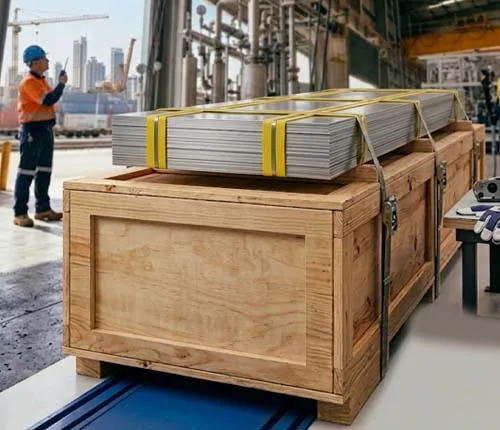 Heavy-duty wooden boxes Packing
We strictly follow seaworthy export handling standards to protect stainless steel 316 plates from transit damage, moisture ingress, and surface contamination during long-distance dispatch.
- Heavy-duty wooden boxes with moisture barrier lining
- HDPE stretch film wrapping on all bundles
- Edge and corner protection with plastic padding
- Silica gel desiccants to minimize moisture exposure
- ISPM-15 fumigated wooden packaging for export
 Plate Bundle Yard
Staging
Plate Bundle Yard
Staging
 Plate Bundle Edge
Protection
Plate Bundle Edge
Protection
 Wrapped Export-Ready
Bundles
Wrapped Export-Ready
Bundles
We Export Worldwide
Sachiya Steel International supplies stainless steel products to major industrial markets across North America, Europe, the Middle East, Asia and Africa with export-ready documentation and logistics support.
 USA
USA Canada
 Germany
 UK
UK Italy
Italy France
 Australia
 South Korea
 Indonesia
 Vietnam
 Singapore
 Malaysia
 Taiwan
 UAE
UAE Saudi Arabia
 Qatar
Qatar Oman
Oman
 South Africa
 Nigeria
 Egypt
Egypt