




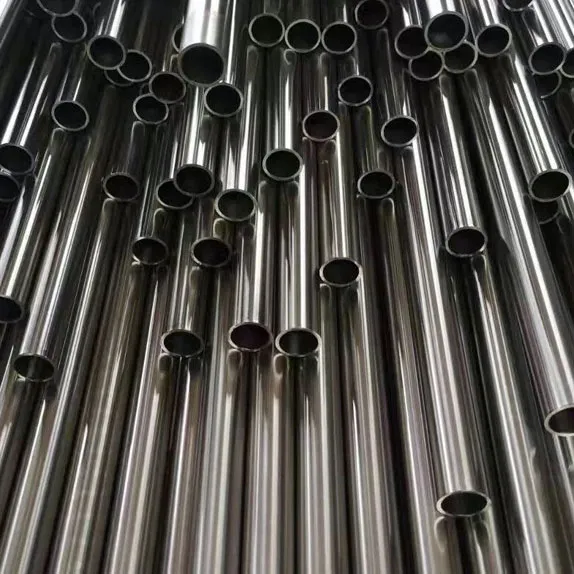
Stainless Steel 316 Instrumentation Tubes Specifications
The following table shows the detailed specifications of Alloy 316 Instrumentation Tubes covering its sizes, form, finishes and other details.
| Parameter | Details |
|---|---|
| Standards | ASTM A213, ASTM A269, EN 10216-5, ASME SA213 |
| Outside Diameter (OD) | 1/16" to 2" (6 mm to 50.8 mm) |
| Wall Thickness | 0.010" to 0.188" (0.2 mm to 4.78 mm) |
| Length | 6 Metres, 20 Feet, or Coiled lengths up to 1000m |
| Forms | Round, Seamless, Straight, or Coiled |
| Finish | Bright Annealed (BA), Polished (Grit 180, 240, 320, 400), AP |
| End Type | Plain End, Bevelled End, Swagelok-type compatible |
| Hardness | Max 80 HRB (Rockwell B) for easy bending/flaring |
Available Sizes of Stainless Steel 316 Instrumentation Tubes
SS 316 instrumentation tubes come in fractional (imperial) and metric outside diameters. Standard straight lengths are 6 metres (20 feet); coils and custom cut-to-length are available as per client specification.
Fractional Sizes (Imperial)
| OD (in.) | Wall Thickness (in.) | Available Walls |
|---|---|---|
| 1/4" | 0.035", 0.049", 0.065" | 3 options |
| 3/8" | 0.035", 0.049", 0.065" | 3 options |
| 1/2" | 0.035", 0.049", 0.065" | 3 options |
Metric Sizes
Metric OD ranges from 6.00 mm to 25.4 mm as standard stock, with sizes up to 60.00 mm available on request. Wall thickness spans 0.6 mm to 6.00 mm.
Stainless Steel 316 Instrumentation Tubes Price
SS 316 instrumentation tube prices in India range from approximately ₹200 to ₹340 per kg and range between $2.85 and $10.50 per kg. International pricing varies by OD, wall thickness, length, quantity, and finish (annealed and pickled vs bright annealed). Raw material market rates also affect the final cost. Contact Sachiya Steel International for a quote on your specific requirements.
Chemical Composition of Stainless Steel 316 Instrumentation Tubes
Grade TP316 chemical composition per ASTM A213 / ASME SA-213 is listed in the table given below.
Mechanical Properties of 316 Stainless Steel Instrumentation Tubes
Per ASTM A213 / ASME SA-213, Grade TP316 instrumentation tubes meet these minimum values.
| Property | Value |
|---|---|
| Tensile Strength (min) | 75 ksi (515 MPa) |
| Yield Strength, 0.2% Offset (min) | 30 ksi (205 MPa) |
| Elongation in 2 in. (min) | 35% |
Equivalent Grades of 316 Stainless Steel Instrumentation Tubing
Stainless Steel 316 carries different designations across international standards. All designations refer to the same austenitic, molybdenum-bearing composition.
| Standard | Designation |
|---|---|
| UNS | S31600 |
| EN | 1.4401 / X5CrNiMo17-12-2 |
| JIS | SUS316 |
| GB | 06Cr17Ni12Mo2 |
| BS | 316S31 |
| AFNOR | Z6CND17-11 |
Pressure Ratings for Stainless Steel 316 Instrumentation Tubing
This table outlines the maximum allowable working pressures for common SS 316 instrumentation tube sizes.
| Tube OD (Inch) | 0.028" WT (psig) | 0.035" WT (psig) | 0.049" WT (psig) | 0.065" WT (psig) | 0.083" WT (psig) |
|---|---|---|---|---|---|
| 1/8" | 8,500 | 10,900 | |||
| 1/4" | 4,000 | 5,100 | 7,500 | 10,200 | |
| 3/8" | 3,300 | 4,800 | 6,500 | ||
| 1/2" | 2,600 | 3,700 | 5,100 | 6,700 | |
| 3/4" | 2,400 | 3,300 | 4,200 | ||
| 1" | 2,400 | 3,100 |
Industrial Applications of Stainless Steel 316 Instrumentation Tubes
SS 316 instrumentation tubes serve 4 major sectors: oil and gas, chemical and petrochemical, power generation, and pharmaceutical/food processing.
Oil & Gas
316 tubes are used for offshore platform pressure lines and seawater hydraulic control systems.
Chemical & Petrochemical Processing
In order to withstand acid and chloride fluids, it is utilised in the sensing lines and gauge connections of the reactor.
Power Generation
Steam pressure sensing circuits and boiler feed-water sampling systems in thermal and nuclear power facilities use 316 SS instrument tubes.
Pharmaceutical & Food Processing
Used in sanitary lines and steam sterilisation systems for high cleanliness and easy maintenance.
Stainless Steel 316 vs Stainless Steel 304 Instrumentation Tubes
SS 316 instrumentation tubes have 2–3.00% molybdenum, unlike SS 304. Molybdenum reduces chloride pitting and crevice corrosion. Select 316 for offshore, marine, and chemical use. SS 304 can handle milder air without chloride.
| Feature | Stainless Steel 316 | Stainless Steel 304 |
|---|---|---|
| Alloying Element | 2.0% - 3.0% Molybdenum | None |
| Pitting Resistance (PREN) | Higher (~24.2) | Lower (~19.0) |
| Chloride Resistance | Excellent (Seawater/Brine) | Susceptible to chloride stress corrosion cracking under certain conditions |
| Surface Finish | Typically Bright Annealed (BA) | Typically Bright Annealed (BA) |
| Typical Application | Oil & Gas, Marine, Pharma | Food, Beverage, HVAC |
| Relative Cost | Premium (~20-30% higher) | Standard / Economical |
Shipping and Packaging
 Heavy-duty wooden boxes Packing
We strictly follow seaworthy export handling standards to protect SS 316 instrumentation tubes from transit damage, moisture ingress, and surface contamination during long-distance dispatch.
- Heavy-duty wooden boxes with moisture barrier lining
- HDPE stretch film wrapping on all bundles
- Plastic end caps on threaded and plain-end pipes
- Silica gel desiccants to minimize moisture exposure
- ISPM-15 fumigated wooden packaging for export
 Pipe Bundle Yard Staging
 Container End-Cap Protection
 Wrapped Export-Ready Bundles
We Export Worldwide
Sachiya Steel International supplies stainless steel products to major industrial markets across North America, Europe, the Middle East, Asia and Africa with export-ready documentation and logistics support.
 USA
USA Canada
 Germany
 UK
UK Italy
Italy France
 Australia
 South Korea
 Indonesia
 Vietnam
 Singapore
 Malaysia
 Taiwan
 UAE
UAE Saudi Arabia
 Qatar
Qatar Oman
Oman
 South Africa
 Nigeria
 Egypt
Egypt