





Cupro Nickel Tube Specifications
Refer to the following technical data for the material specifications of high-performance Cupro Nickel Tubes, widely utilised in marine and industrial heat exchange systems.
| Property | Specification / Details |
|---|---|
| Common Grades | CuNi 90/10 (C70600), CuNi 70/30 (C71500) |
| Standard | ASTM B111, B466, ASME SB111, SB466, DIN 86019 |
| Outside Diameter (OD) | 6.0 mm to 219 mm (1/4" to 6") |
| Wall Thickness (WT) | 0.5 mm to 10 mm |
| Length | Up to 12 Metres (Single/Double Random) |
| Manufacturing Type | Seamless, Welded, Fabricated |
| Testing | Eddy Current, Hydrostatic, Pneumatic, Visual |
Cupro Nickel Tube Sizes
The available sizes of carbon steel tubes are mentioned in the table given below.
Standard OD and Wall Thickness Dimensions
The table below shows common OD and wall thickness combinations for copper nickel tubing.
| OD (mm) | OD (inches) | Wall Thickness (mm) |
|---|---|---|
| 6.35 | 1/4" | 0.71 - 1.24 |
| 9.53 | 3/8" | 0.89 - 1.65 |
| 12.70 | 1/2" | 0.89 - 2.11 |
| 19.05 | 3/4" | 1.07 - 2.77 |
| 25.40 | 1" | 1.24 - 3.40 |
| 38.10 | 1-1/2" | 1.65 - 3.68 |
| 50.80 | 2" | 1.65 - 5.08 |
| 76.20 | 3" | 2.11 - 5.49 |
| 101.60 | 4" | 2.77 - 5.74 |
| 152.40 | 6" | 3.40 - 7.11 |
| 219.08 | 8" | 3.76 - 10.00 |
Standard lengths: 3 metres, 6 metres, and custom cut-to-length.
Cupro Nickel Tube Weight Formula
Weight per metre depends on OD, wall thickness, and alloy density. The formula is:
Weight (kg/m) = pi x (OD - WT) x WT x density / 1,000,000
Density values: 8.9 g/cm3 for 90/10 (C70600) and 8.95 g/cm3 for 70/30 (C71500). All dimensions in millimetres.
Cupro Nickel Tube Price
Depending on the standard and the amount ordered, India costs between Rs 500 and Rs 1,500 per kg. Most of the time, 90/10 seamless tubes cost $6 to $12 per kg (FOB). The price of cupro nickel tubes is based on their grade, outer diameter, wall thickness, length, quantity, and the LME market values for copper and nickel. The 70/30 grade costs extra since it has more nickel in it. Our sales team can provide you a detailed quote and the current price.
Cupro Nickel Tube Grades
The two primary cupro nickel tube grades are 90/10 (C70600) and 70/30 (C71500). Grade selection depends on service severity, operating temperature, and budget.
90/10 Cupro Nickel Tube (C70600)
The 90/10 grade is composed of 90% copper, 10% nickel, 1.0–1.8% iron, and 1.0% manganese. Corrosion resistance is satisfactory at lower seawater velocities of up to 3.5 m/s. In shipyards and desalination plants, C70600 is used for intake and discharge piping. This alloy is designated as CDA 706.
70/30 Cupro Nickel Tube (C71500)
C71500 contains 29-33% nickel, which increases tensile strength and erosion resistance at 4.5 m/s seawater. Naval and offshore platforms use this grade for critical cooling. The nickel-rich type costs more than the 90/10 version.
Types of Cupro Nickel Tubes
Cupro nickel tubes are produced in 4 main configurations: seamless, welded, finned, and U-bend.
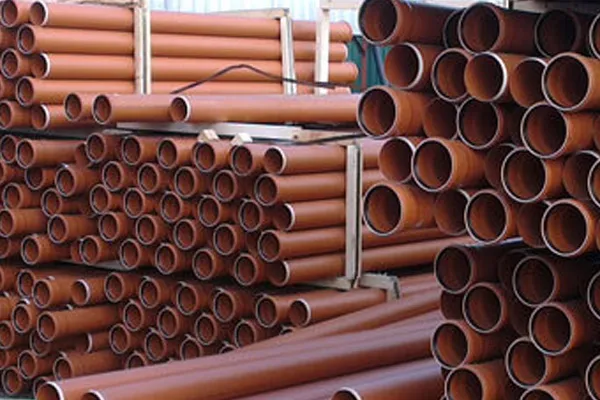
Seamless Cupro Nickel Tube
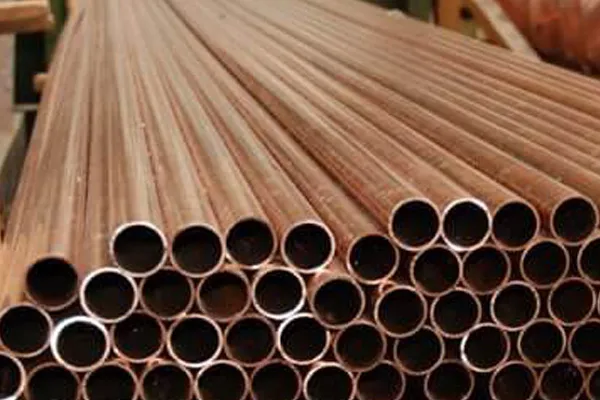
Welded Cupro Nickel Tube
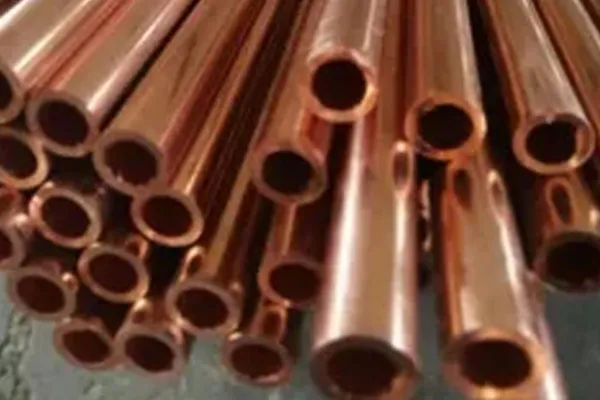
Finned Cupro Nickel Tube
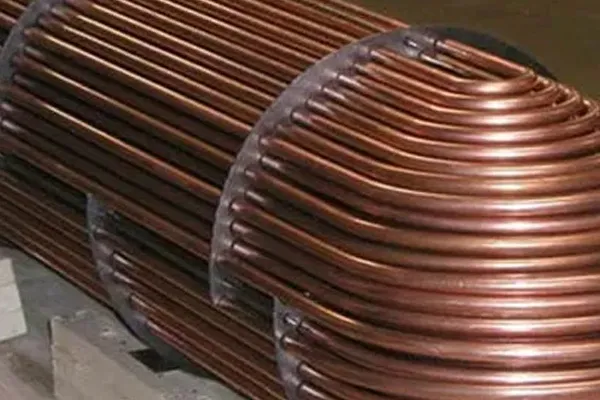
U-Bend Cupro Nickel Tube
Cupro Nickel Tube Industrial Applications
Cupro nickel tubes find use across 5 major industrial sectors due to their seawater corrosion resistance and anti-biofouling properties.
Marine & Shipbuilding
CuNi tubes are standard for commercial and naval seawater plumbing. Ballast systems, fire-fighting lines, and cooling circuits use copper nickel tubing for saltwater durability.
Heat Exchangers & Condensers
Seawater flows through 90/10 and 70/30 condenser tubes without pitting or erosion. Shell-and-tube heat exchangers in power plants and factories require these tubes for reliability.
Desalination Plants
Copper nickel tubes resist the hot, concentrated brine found in multi-stage flash and multi-effect distillation units. The 90/10 grade is most commonly specified for evaporator tube bundles.
Oil & Gas
Offshore platforms use copper-nickel tubes for seawater lift, firewater, and cooling systems. The alloy's resistance to chloride-bearing fluids makes it well-suited for both subsea and topside applications.
Power Generation
Thermal and nuclear power stations use CuNi condenser tubes to cool exhaust steam. The alloy's resistance to biofouling reduces maintenance intervals and keeps heat transfer efficiency high.
90/10 vs 70/30 - Grade Comparison for Tube Selection
The table that follows provides a comparison of important characteristics for selecting tube grades.
| Property | 90/10 (C70600) | 70/30 (C71500) |
|---|---|---|
| Nickel Content | 9-11% | 29-33% |
| Tensile Strength | 275 MPa min | 360 MPa min |
| Max Seawater Velocity | 3.5 m/s | 4.5 m/s |
| Relative Cost | Lower | Higher |
| Typical Use | General marine piping | High-velocity, aggressive service |
Shipping & Packaging
 Heavy-duty wooden boxes Packing
We strictly follow seaworthy export handling standards to protect cupro nickel tube from transit damage, moisture ingress, and surface contamination during long-distance dispatch.
- Heavy-duty wooden boxes with moisture barrier lining
- HDPE stretch film wrapping on all bundles
- Plastic end caps on threaded and plain-end pipes
- Silica gel desiccants to minimize moisture exposure
- ISPM-15 fumigated wooden packaging for export
 Pipe Bundle Yard
Staging
Pipe Bundle Yard
Staging
 Container End-Cap
Protection
Container End-Cap
Protection
 Wrapped Export-Ready
Bundles
Wrapped Export-Ready
Bundles
We Export Worldwide
Sachiya Steel International supplies Copper Nickel products to major industrial markets across North America, Europe, the Middle East, Asia and Africa with export-ready documentation and logistics support.
 USA
USA Canada
 Germany
 UK
UK Italy
Italy France
 Australia
 South Korea
 Indonesia
 Vietnam
 Singapore
 Malaysia
 Taiwan
 UAE
UAE Saudi Arabia
 Qatar
Qatar Oman
Oman
 South Africa
 Nigeria
 Egypt
Egypt