




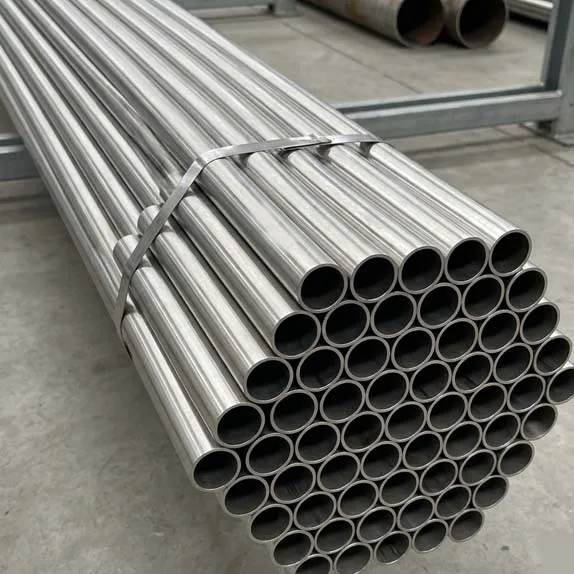
Stainless Steel 304L Pipe Specifications
Refer to the following standard technical specifications for 304L stainless steel pipe, standard, type, size, range and other required information.
| Parameter | Details |
|---|---|
| Standard | ASTM A312 / ASME SA312 |
| Type | Seamless, ERW, Welded, Fabricated |
| Size Range | 10.3 mm OD to 914.4 mm OD (Up to 24” NB available Ex-stock) |
| Wall Thickness | 1.24 mm to 59.54 mm (SCH 10S at NPS 1/8 to SCH 160 at NPS 24) |
| Schedule | SCH 5S, 10S, 40S, 80S, 160, XXS |
| Form | Round, Square, Rectangular, Coiled, “U" -Shape, Hydraulic |
| Length | Single Random, Double Random, Required/Custom Length |
| End Type | Plain End, Bevelled End, Threaded (with Plastic Cap protection) |
| Surface Finish | 2B, No. 4, No. 1, No. 8 Mirror Finish, Customer-specific finishes |
304L Stainless Steel Pipe Sizes and Dimensions
304L stainless steel pipe is available in nominal pipe sizes from 1/8" to 36" NPS (DN6 to DN900), in schedules 5S, 10S, 40S, 80S, 160, and XXS. Standard lengths are 20-foot random with double random and cut-to-length options on request.
The table below shows Sachiya Steel International's full size range.
| Parameter | Range |
|---|---|
| Nominal Pipe Size (NPS) | 1/8" to 36" (DN6 to DN900) |
| Outside Diameter (OD) | 0.405" to 36" |
| Schedules | 5S, 10S, 40S, 80S, 160, XXS |
| Standard Lengths | 20 ft single random, double random |
| Custom Lengths | Available on request |
Pipe Schedule and Weight Chart
This chart shows the outside diameter, wall thickness and weight per foot for common NPS sizes in Schedule 10S, 40S and 80S. Wall thicknesses are per ASME B36.19M. Weights are calculated using a stainless steel density of 0.29 lb/in³, and are close enough for estimating; actual weight varies slightly with mill tolerance. For other schedules see our stainless steel pipe weight chart or use the weight calculator.
| NPS | OD (in.) | Sch 10S Wall (in.) | Sch 10S Wt (lb/ft) | Sch 40S Wall (in.) | Sch 40S Wt (lb/ft) | Sch 80S Wall (in.) | Sch 80S Wt (lb/ft) |
|---|---|---|---|---|---|---|---|
| 1/2" | 0.840 | 0.083 | 0.69 | 0.109 | 0.87 | 0.147 | 1.11 |
| 3/4" | 1.050 | 0.083 | 0.88 | 0.113 | 1.16 | 0.154 | 1.51 |
| 1" | 1.315 | 0.109 | 1.44 | 0.133 | 1.72 | 0.179 | 2.22 |
| 1-1/2" | 1.900 | 0.109 | 2.13 | 0.145 | 2.78 | 0.200 | 3.72 |
| 2" | 2.375 | 0.109 | 2.70 | 0.154 | 3.74 | 0.218 | 5.14 |
| 3" | 3.500 | 0.120 | 4.43 | 0.216 | 7.76 | 0.300 | 10.50 |
| 4" | 4.500 | 0.120 | 5.75 | 0.237 | 11.05 | 0.337 | 15.34 |
| 6" | 6.625 | 0.134 | 9.51 | 0.280 | 19.42 | 0.432 | 29.25 |
| 8" | 8.625 | 0.148 | 13.72 | 0.322 | 29.23 | 0.500 | 44.41 |
| 10" | 10.750 | 0.165 | 19.09 | 0.365 | 41.44 | 0.500 | 56.03 |
| 12" | 12.750 | 0.180 | 24.74 | 0.375 | 50.73 | 0.500 | 66.96 |
304L Stainless Steel Pipe Price
304L stainless steel pipe pricing typically ranges from ₹195 to ₹350 per kilogram (India, ex-works Mumbai), which is roughly $2.29 to $4.12 per kilogram, depending on size, schedule, and quantity ordered. These are indicative figures; actual pricing shifts with nickel and chromium market rates.
Several factors affect the final cost per unit. Seamless pipe is priced at a higher price compared to welded pipe, with a typical increase of 15 to 30% for the same dimension and schedule. The cost of heavy schedules and larger diameters is higher per foot, but it is lower per kilogram as a result of production efficiencies. Volume matters: orders over 500 kg get better per-kilogram pricing.
Sachiya Steel International competes on price without hidden fees. Every order includes soft copies of mill test, quality, and material traceability certificates. Contact us for current prices on your size and schedule.
Chemical Composition of ASTM A312 TP304L Pipe
The table below lists each element and its permitted range per ASTM A312/ASME SA312 for Grade TP304L (UNS S30403). ASTM A312 304L stainless steel contains 18–20% chromium and 8–13% nickel for corrosion protection and structural stability. Its low 0.035% carbon ceiling prevents welding sensitisation, making it the premier grade for durable, welded piping systems.
Pitting Resistance Equivalent Number (PREN) rates how well a grade resists pitting in chloride environments. It is worked out as PREN = %Cr + 3.3 × %Mo + 16 × %N. Applying that to the composition above gives 304L a PREN of 18.0 to 21.6. With no molybdenum, 304L relies on chromium alone. Where chlorides are present, 316L pipe (PREN 22.6 to 29.5) is the usual step up.
Mechanical Properties of 304L Stainless Steel Pipe
The following table shows the minimum mechanical requirements per ASME SA312 for Grade TP304L.
304L yields at about a third of its tensile strength, so it work-hardens readily and takes cold bending and forming well. The 35% minimum elongation means the pipe stretches a long way before it fails. Engineers should note that mill test results commonly surpass these minimum promised values by 10–15%.
| Property | Value | Unit |
|---|---|---|
| Tensile Strength (min) | 70 / 485 | ksi / MPa |
| Yield Strength (min) | 25 / 170 | ksi / MPa |
| Elongation (min. 2 in.) | 35 | % |
Stainless Steel 304L Pipe Equivalent Grades
This table identifies global equivalents for 304L stainless steel pipe, helping you cross-reference international standards like ASTM, DIN, and JIS.
| Standard / Region | Designation |
|---|---|
| USA | UNS S30403 |
| Germany / EU (EN/DIN) | 1.4307 / X2CrNi18-9 |
| Japan (JIS) | SUS 304L |
| China (GB) | 022Cr19Ni10 (Old: 00Cr19Ni10) |
| UK (BS) | 304S11 |
| Russian (GOST) | 03Ch18N11 |
Industrial Applications of 304L Stainless Steel Pipe
304L stainless pipes are used in chemical processing, food and beverage, oil and gas, and cryogenic service. They suit these demanding industrial situations because they are easy to weld and do not rust easily.
Chemical Processing
Chemical plants utilise 304L pipes for transfer lines handling organic acids and alkaline solutions. Low carbon resists sensitisation in the 450–850°C range.
Food & Beverage
Breweries and dairies use 304L for clean process piping. The material's durability to clean-in-place chemicals satisfies sanitary application criteria with proper surface finish and food-contact laws.
Oil & Gas
304L pipes are used in instrument tubing, water injection, and utility lines. These components ensure consistent performance in glycol lines and non-chloride gas sweetening units for various processing plants.
Cryogenic Service
Transferring LNG and liquid nitrogen is critical. 304L maintains strong ductility and structural integrity at extreme temperatures as low as -196°C without brittle transition.
304 vs 304L Stainless Steel Pipe: Key Differences
Use this table to determine which specification meets your project’s strength and corrosion requirements.
Due to its low carbon content, 304L avoids intergranular corrosion in welded joints. Specifying this grade ensures strong mechanical strength and carbide precipitation resistance. The "L" in 304L is the lower carbon ceiling, 0.035% against 0.08% for standard 304 pipe.
| Feature | Stainless Steel 304 | Stainless Steel 304L |
|---|---|---|
| Carbon Content (Max) | 0.08% | 0.035% |
| Tensile Strength (Min) | 75 ksi (515 MPa) | 70 ksi (485 MPa) |
| Yield Strength (Min) | 30 ksi (205 MPa) | 25 ksi (170 MPa) |
| Welding Performance | Risk of carbide precipitation | Prevents intergranular corrosion |
| Post-Weld Treatment | Often required | Generally not required |
| Best Use Case | High-strength structural parts | Welded piping systems |
Shipping & Packaging
 Heavy-Duty Wooden Box Packing
Every 304L order is packed for sea freight: pipe ends capped, bundles strapped and film-wrapped, and crated in ISPM-15 timber.
- Heavy-duty wooden boxes or strapped bundles, with moisture barrier lining
- LLDPE stretch film wrapping on all bundles
- Plastic end caps on threaded and plain-end pipes
- Silica gel desiccants to minimise moisture exposure
- ISPM-15 compliant wooden packaging for export
 Pipe Bundle Yard Staging
 Pipe End-Cap Protection
 Wrapped Export-Ready Bundles
We Export Worldwide
Sachiya Steel International supplies stainless steel products to major industrial markets across North America, Europe, the Middle East, Asia and Africa with export-ready documentation and logistics support.
 USA
 Canada
 Germany
 UK
 Italy
 France
 Australia
 South Korea
 Indonesia
 Vietnam
 Singapore
 Malaysia
 Taiwan
 UAE
 Saudi Arabia
 Qatar
 Oman
 South Africa
 Nigeria
 Egypt
