




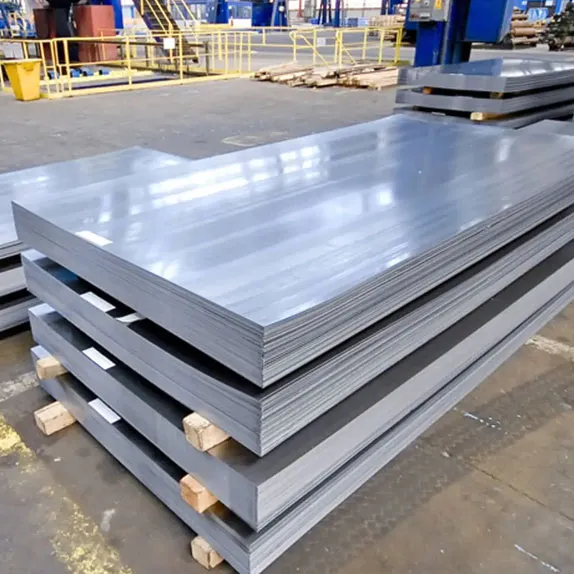
Specifications of ASTM A387 Grade 22 Plate
The specifications of Grade 22 plates, including standards, dimensions, forms, finishes, and more, are listed in the table below.
| Parameter | Specification |
|---|---|
| Standard | ASTM A387 / ASME SA387 |
| Thickness Range | 3/16 inch (4.70 mm) to 4 inches (91.4 mm) |
| Width Range | up to 131.9 inches (3,350 mm) |
| Length Range | up to 590 inches (15,000 mm) |
| Heat Treatment | Normalized & Tempered |
| Surface Finish | Hot Rolled (HR), Shot Blasted, Pickled |
| Edge Condition | Mill Edge / Trimmed Edge |
| Supply Condition | Heat treated (Normalised or Quenched & Tempered as applicable) |
Available Sizes and Dimensions
A387 Gr.22 plates are stocked in sizes covering most pressure vessel requirements.
Thickness Range
The thickness range of ASTM A387 Grade 22 plates covers both standard and heavy-duty applications.
| Thickness (Inches) | Thickness (mm) |
|---|---|
| 3/16" | 4.70 mm |
| Up to 4" | 91.4 mm |
| Above 2" | Above 50.8 mm |
Width and Length Options
ASTM A387 Grade 22 plates are available in multiple widths and lengths, with options for custom sizes based on project requirements.
| Parameter | Range (Inches) | Range (mm) |
|---|---|---|
| Width | 60" – 131.9" | 1,500 – 3,350 mm |
| Stock Widths | 96", 120" | 2,438 mm, 3,048 mm |
| Length | 73" – 590" | 1,900 – 15,000 mm |
ASTM A387 Gr.22 Plate Price
A387 Gr.22 plates cost ₹98 and ₹200 per kg in India and $1.50 to $3.00 per kg in international markets. The final price depends on class, thickness, dimensions, quantity, and testing requirements (HIC, NACE, UT). Class 2 costs more than Class 1. Request a quote from Sachiya Steel International for current pricing.
Chemical Composition of ASTM A387 Grade 22 Plates
The table below lists the chemical composition per heat and product analysis. Chromium at 2.00 to 2.50% delivers high-temperature oxidation resistance. Molybdenum at 0.90 to 1.10% raises creep-rupture strength. Low carbon supports weldability and reduces the risk of sensitisation during PWHT.
Mechanical Properties of ASTM A387 Gr.22 Plates
SA-387 Gr.22 plates are supplied in Class 1 and Class 2. Both share 18% minimum elongation in 2 inches (50 mm).
Class 1 (Normalised and Tempered)
Class 1 plates provide the standard strength level for moderate-pressure service.
| Property | Value |
|---|---|
| Tensile Strength | 60 to 85 ksi (415 to 585 MPa) |
| Yield Strength, min | 30 ksi (205 MPa) |
| Elongation, min | 18% |
Class 2 (Quenched and Tempered)
Class 2 is the higher-strength option, more common in oil and gas applications.
| Property | Value |
|---|---|
| Tensile Strength | 75 to 100 ksi (515 to 690 MPa) |
| Yield Strength, min | 45 ksi (310 MPa) |
| Elongation, min | 18% |
ASTM A387 Grade 22 Equivalent Designations
The table below maps international equivalents for A387 Grade 22.
| Standard | Designation |
|---|---|
| UNS | UNS K21590 |
| EN 10028-2 | 10CrMo9-10 (W.Nr. 1.7380) |
| JIS G4109 | SCMV 4 |
| GB 713 | 12Cr2Mo1R |
PWHT is typically required after welding.
Industrial Applications of ASTM A387 Gr.22 Plates
A387 Gr.22 chrome moly plates serve industries where high-temperature pressure containment is critical.
Oil, Gas, and Petrochemical Industry
Hydrocracker reactors, hydrotreaters, and hydrogen reformer vessels use A387 Grade 22 Class 2 as shell material. Sour gas (H2S) service may require HIC testing per NACE TM0284.
Power Generation
Boiler drums and superheater headers in thermal power plants rely on the 2.25Cr-1Mo composition for steam oxidation resistance.
Chemical Processing
Heat exchangers and reaction vessels handling corrosive media at high temperatures use these plates.
ASTM A387 Grade 22 vs Grade 11 Plates
This table provides a comparison of Grade 22 and Grade 11 in terms of chemical composition, mechanical properties, and typical application suitability.
| Property | Grade 22 (Class 2) | Grade 11 (Class 2) |
|---|---|---|
| Chromium (%) | 2.00 – 2.50 | 1.00 – 1.50 |
| Molybdenum (%) | 0.90 – 1.10 | 0.44 – 0.65 |
| Tensile Strength (ksi) | 75 – 100 | 75 – 100 |
| Yield Strength, min (ksi) | 45 | 45 |
| High Temperature Performance | Better above 450°C | Suitable for moderate temperatures |
| Hydrogen Resistance | Excellent (preferred in hydrogen-rich environments) | Moderate |
| Cost Consideration | Higher | More economical |
| Typical Applications | High-temperature pressure vessels, reactors, and petrochemical plants | Boilers, pressure vessels at moderate temperatures |
Heat Treatment Requirements
A387 Gr.22 plates are supplied thermally treated. The heat treatment cycle determines Class 1 or Class 2 properties.
-
Class 1: Normalising and (tempering optional)
- Class 1 plates are heated above the upper critical temperature, air-cooled, then tempered at a minimum of 1,250 °F (675 °C). This cycle refines grain structure and improves toughness.
-
Class 2: Quenching and Tempering
- Class 2 plates are austenitised, water or oil quenched. Then they are tempered at a minimum of 1,250 °F (675 °C). Quenching produces a finer microstructure with higher strength.
Shipping & Packaging
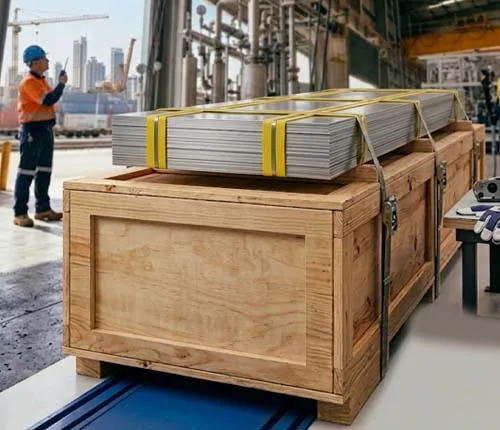 Heavy-duty wooden boxes Packing
We strictly follow seaworthy export handling standards to protect ASTM A387 Gr.22 Plates from transit damage, moisture ingress, and surface contamination during long-distance dispatch.
- Heavy-duty wooden boxes with moisture barrier lining
- HDPE stretch film wrapping on all bundles
- Plastic end caps on threaded and plain-end plate
- Silica gel desiccants to minimize moisture exposure
- ISPM-15 fumigated wooden packaging for export
 Plate Bundle Yard
Staging
Plate Bundle Yard
Staging
 Plate Bundle Edge Protection
 Wrapped Export-Ready
Bundles
Wrapped Export-Ready
Bundles
We Export Worldwide
Sachiya Steel International supplies Alloy steel products to major industrial markets across North America, Europe, the Middle East, Asia and Africa with export-ready documentation and logistics support.
 USA
USA Canada
 Germany
 UK
UK Italy
Italy France
 Australia
 South Korea
 Indonesia
 Vietnam
 Singapore
 Malaysia
 Taiwan
 UAE
UAE Saudi Arabia
 Qatar
Qatar Oman
Oman
 South Africa
 Nigeria
 Egypt
Egypt