





Specifications of Stainless Steel 347 Plates
Niobium is the whole reason this grade exists, and it is specified where welds will sit in the sensitising range in service rather than for the room-temperature corrosion resistance that most of the stainless steel plate range is bought for.
| Property | Details |
|---|---|
| Standard | ASTM A240 / ASME SA-240, ASTM A480 |
| Thickness | 3/16 inches (4.76 mm) to 4 inches (101.6 mm) |
| Standard Width | 1000 mm to 2500 mm |
| Standard Length | 2000 mm to 6000 mm |
| Common Stock Sizes | 4 ft × 8 ft, 5 ft × 10 ft, custom-cut to size |
| Finish | No. 1 (HRAP), 2B, BA, No. 4, No. 8 mirror |
| Form | Flat plate, cut-to-size blanks |
| Condition | Hot rolled, annealed, and pickled |
| Processing | Cutting, bending, machining, and surface polishing |
Available Sizes for Stainless Steel 347 Plates
SS 347 plates are available in thicknesses from 3/16 inches (4.76 mm) to 4 inches (101.6 mm). Standard stock is 2500 mm wide and 6000 mm long; wider and longer sizes are rolled to order.
| Dimension | Range |
|---|---|
| Thickness | 3/16 inches (4.76 mm) to 4 inches (101.6 mm) |
| Width | 48 inches (1219 mm), 60 inches (1524 mm), 72 inches (1829 mm), 96 inches (2438 mm), 120 inches (3048 mm) |
| Length | Up to 240 inches (6096 mm); up to 480 inches (12192 mm) from the plate mill |
SS UNS S34700 Plate Weight Chart
347 weighs 8.00 g/cm³, so a square metre carries 8 kg for every millimetre of thickness and the rows below run that across the stock range. Published mill figures sit between 7.96 and 7.98, so treat these as nominal and order against the mill certificate for anything load-bearing.
| Thickness (mm) | Thickness (inch) | Weight (kg/m²) | Weight (lb/ft²) |
|---|---|---|---|
| 4.76 mm | 0.187 inches | 38.1 kg | 7.80 lb |
| 6.0 mm | 0.236 inches | 48.0 kg | 9.83 lb |
| 8.0 mm | 0.315 inches | 64.0 kg | 13.11 lb |
| 10.0 mm | 0.394 inches | 80.0 kg | 16.39 lb |
| 12.0 mm | 0.472 inches | 96.0 kg | 19.66 lb |
| 16.0 mm | 0.630 inches | 128.0 kg | 26.22 lb |
| 20.0 mm | 0.787 inches | 160.0 kg | 32.77 lb |
| 25.0 mm | 0.984 inches | 200.0 kg | 40.96 lb |
| 30.0 mm | 1.181 inches | 240.0 kg | 49.16 lb |
| 40.0 mm | 1.575 inches | 320.0 kg | 65.54 lb |
| 50.0 mm | 1.969 inches | 400.0 kg | 81.93 lb |
| 60.0 mm | 2.362 inches | 480.0 kg | 98.31 lb |
| 75.0 mm | 2.953 inches | 600.0 kg | 122.89 lb |
| 90.0 mm | 3.543 inches | 720.0 kg | 147.47 lb |
| 101.60 mm | 4.000 inches | 812.8 kg | 166.47 lb |
Forms
SS 347 plates are usually supplied in hot-rolled, annealed and pickled (HRAP) condition. Under ASTM A480, material 3/16 inches (4.76 mm) and over is plate when it is wider than 10 inches, and thinner material 24 inches and wider is sheet.
Surface Finishes
- 2B Finish
- No. 1 Finish (Hot Rolled Annealed & Pickled – HRAP)
- BA Finish (Bright Annealed)
- No. 4 Finish
- No. 8 Finish (Mirror Finish)
Extra-Wide 347 Plate and Weld Metal Soundness
Standard stock stops at 2500 mm and the mill range reaches 120 inches, which is 3048 mm. Above 2500 mm the plate is quarto-rolled to the order, so the widest sizes carry a lead time that stock sizes do not.
Niobium is what makes 347 weld metal awkward to lay down. It forms low-melting films late in solidification, so 347 deposits are more hot-crack sensitive than plain 18-10, and fabricators hold a few per cent ferrite in the weld to stop it. Width does not change that, it changes how often you have to get it right: covering 9 metres takes four plates at 2500 mm and three at 3048 mm, which is one seam fewer.
347 Plate Price in India
Stainless Steel 347 plate prices in India are typically between ₹280 and ₹390 per kg, depending on thickness and order quantity. In the United States, prices can range from about $3.29 to $4.59 per kg, depending on the plate dimensions and the surface finish. The final price is influenced by thickness, width, length, surface finish, order quantity, and current raw material costs. For an exact and up-to-date quotation, please contact our sales team.
Chemical Composition of Stainless Steel 347 Plates
The table below lists the chemical composition of ASTM A240 Type 347 plate per ASME SA-240. Niobium stabilisation is the defining feature of this grade.
Mechanical Properties of Stainless 1.4550 Plate
ASTM A240 Type 347 plate has a minimum tensile strength of 75 ksi (515 MPa) and a yield strength of 30 ksi (205 MPa). The values below are as per ASME SA-240.
| Property | Details |
|---|---|
| Tensile Strength (min) | 75 ksi (515 MPa) |
| Yield Strength, 0.2% Offset (min) | 30 ksi (205 MPa) |
| Elongation in 2 inches (min) | 40% |
| Hardness (max) | 201 HBW / 92 HRB |
Equivalent Grades of Stainless Steel 347 Plates
The eight designations below describe one chemistry, 18Cr-11Ni stabilised with niobium, so a drawing calling for 1.4550, SUS 347 or 08Kh18N12B is asking for the same plate as one calling for S34700.
| Country / Standard | Designation |
|---|---|
| UNS | S34700 |
| Europe (EN) | 1.4550 (X6CrNiNb18-10) |
| Japan (JIS) | SUS 347 |
| China (GB/T) | 0Cr18Ni11Nb |
| UK (BS) | 347S31 |
| South Korea (KS) | STS 347 |
| France (AFNOR) | Z6CNNb18-10 |
| Russia (GOST) | 08Kh18N12B |
Industrial Applications of Stainless Steel 347 Plates
SS 347 plates are mainly used in four major industries. Their strong resistance to corrosion at high temperatures makes them a good choice for equipment in these sectors.
Refinery Reactor Vessels and Columns
Alloy 347 plates are used in reactor vessels, heat exchangers and distillation columns exposed to high temperatures and corrosive media in refineries and chemical plants.
Power Generation and Waste Heat Recovery
Type 347 plate serves in superheater tubing support plates, recuperators and boiler components that operate above 800 degrees F for extended periods.
Sterilisation Vessels and Cycling Tanks
The grade’s resistance to sensitisation makes it suitable for sterilisation vessels and process tanks that undergo repeated heating and cooling cycles.
Aerospace Components
SS 347 plates conforming to AMS 5512 are used in aircraft exhaust stacks, collector rings and engine components where high-temperature strength is required.
Stainless Steel 347 vs 347H Plate
Carbon is the difference. 347 caps it at 0.08% while 347H runs 0.04% to 0.10%, and the niobium minimum drops from ten times carbon to eight times to suit the higher range. That extra carbon is what gives 347H its creep strength in sustained high-temperature service, and plate landing between 0.04% and 0.08% can be certified to both grades.
| Parameter | Stainless Steel 347 Plate | Stainless Steel 347H Plate |
|---|---|---|
| Carbon Content | Max 0.08% | 0.04% – 0.10% |
| Grade Type | Standard stabilised austenitic grade | High-carbon version of 347 |
| High-Temperature Performance | Suitable for moderate temperatures | Improved creep resistance at high temperatures |
| Temperature Suitability | Below 1000°F (537°C) | Above 1000°F (537°C) |
| Creep Resistance | Standard | Enhanced due to higher carbon |
| Typical Application | General corrosion and moderate heat service | Pressure vessels and sustained high-temperature service |
| Dual Certification | Possible (when carbon overlaps) | Possible (0.04–0.08% carbon range) |
347 vs 321 Stainless Steel Plate for High-Temperature Service
Both grades are stabilised against carbide precipitation, 347 with niobium and 321 with titanium. Titanium oxidises away across the arc in shielded welding while niobium carries through, which is why field-welded refinery work usually specifies 347 over SS 321 plate.
| Parameter | Stainless Steel 347 Plate | Stainless Steel 321 Plate |
|---|---|---|
| Stabilising Element | Niobium (Columbium) | Titanium |
| Grade Type | Nb-stabilised austenitic stainless steel | Ti-stabilised austenitic stainless steel |
| Intergranular Corrosion Resistance | Very good | Very good |
| Performance in Oxidising Environments | Slightly better | Good |
| Polythionic Acid Resistance | Preferred choice | Less preferred |
| Typical Applications | Petroleum refining, chemical processing | Aerospace, high-temperature equipment |
| Selection Criteria | Used where Nb stabilisation is preferred | Used when Ti stabilisation is specified by design codes |
347 Plate in Polythionic Acid Service
Sulphur in the feed builds an iron sulphide scale inside refinery equipment. The scale is harmless while the unit is hot and sealed, but a vessel opened for a turnaround lets air and moisture reach it, and the scale turns to polythionic acid. The attack follows chromium-depleted grain boundaries rather than cutting across the grains, which is why it turns up at welds and bends and not in flat parent metal.
Niobium is what keeps those boundaries clear, because it takes the carbon before chromium can. Welding undoes it locally, since the heat-affected zone sees carbide dissolution temperature again, and a stabilising heat treatment after welding is the recognised way to put it back. Protecting the equipment through the shutdown itself is a separate job, and that is what NACE SP0170 covers.
Shipping & Packaging
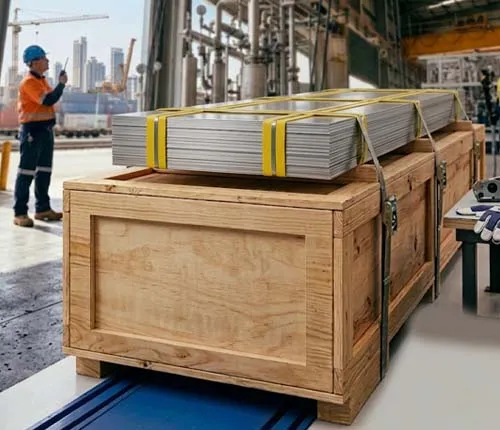 Heavy-Duty Wooden Box Packing
SS 347 plate at four inches thick will mark whatever it is stacked against, so edges and corners are padded before bundling.
- Heavy-duty wooden boxes or strapped bundles, with moisture barrier lining
- LLDPE stretch film wrapping on all bundles
- Edge and corner protection with plastic padding
- Silica gel desiccants to minimise moisture exposure
- ISPM-15 compliant wooden packaging for export
 Plate Bundle Yard
Staging
 Plate Bundle Edge
Protection
 Wrapped Export-Ready
Bundles
We Export Worldwide
Sachiya Steel International supplies stainless steel products to major industrial markets across North America, Europe, the Middle East, Asia and Africa with export-ready documentation and logistics support.
 USA
 Canada
 Germany
 UK
 Italy
 France
 Australia
 South Korea
 Indonesia
 Vietnam
 Singapore
 Malaysia
 Taiwan
 UAE
 Saudi Arabia
 Qatar
 Oman
 South Africa
 Nigeria
 Egypt
