





Stainless Steel Pipe Specifications
The table below lists specification parameters for stainless steel pipes, including standards, grades, dimensions, finishes, end forms, and other requirements.
| Parameter | Details |
|---|---|
| Standard | ASTM A312 / ASME SA-312, ASTM A358, ASTM A790 |
| Grades | 304, 304L, 316, 316L, 321, 347, 310S, 317L, 904L, 254 SMO, Alloy 20 |
| Size Range | NPS 1/8" to 36"+ (DN 6 to DN 900+) |
| Schedule | 5s, 10s, 40s, 80s, 160, XXH |
| Length | 20 feet (6 metres), random and double-random |
| Form | Seamless, Welded (ERW, EFW), Square, Round |
| End Type | Plain end, bevelled end, threaded |
| Finish | Mill finish, polished |
Stainless Steel Pipe Sizes
Available sizes start at NPS 1/8" and go up to 36"+. Schedule options: 5s, 10s, 40s, 80s, 160, and XXH. Standard length is 20 feet (6 metres), with random, double-random, and custom cut-to-length also available.
Stainless Steel Pipe Price
SS pipe pricing ranges from ₹185 to ₹450 per kg (INR) or $3 to $15 per kg (USD) depending on grade, size, schedule, and quantity. Grade 316 commands a 15-25% premium over 304. Prices shift with nickel and chromium market rates, so contact us for a current quote.
Stainless Steel Pipe Grades
Stainless Steel pipes are available in austenitic grades (304, 316, 310, 317L, 321, 347) per ASTM A312 and speciality alloys (904L, 254 SMO, Alloy 20) for aggressive environments.
Austenitic Grades (300 Series)
Grade 304 / 304L is the most widely used SS pipe grade with 18% Cr and 8-11% Ni. 304L (0.030% max C) prevents sensitisation in welded joints.
Grade 316 / 316L contains 2-3% molybdenum for superior chloride and pitting resistance. Standard choice for pharmaceutical and marine piping.
Grade 321 / 321H is titanium-stabilised for continuous service up to 870°C. Used in exhaust systems and refinery piping.
Grade 347 is niobium-stabilised with better creep resistance than 321. Specified for power generation and aerospace piping.
Grade 310 / 310S has high chromium (24-26%) and nickel (19-22%) for extreme heat up to 1150°C. Used in furnace components and flare stacks.
Grade 317L consists of 3-4% Mo. It is good at resisting sulphuric and acetic acids in chemical processing.
Speciality & Super Austenitic Grades
Grade 904L is a super austenitic alloy with 23-28% Ni, 4-5% Mo, and 1-2% Cu for sulphuric acid service.
254 SMO contains 6% Mo with PREN above 40. Highest pitting resistance among the widely used austenitic grades, serving seawater desalination.
Alloy 20 is a high-nickel (32-38% Ni) alloy with copper addition, built for sulphuric acid piping and chemical mixing tanks.
Types of Stainless Steel Pipes
Stainless steel pipes fall into 3 manufacturing categories, each with different pressure, cost, and diameter characteristics.

Seamless Stainless Steel Pipes

Welded Stainless Steel Pipes
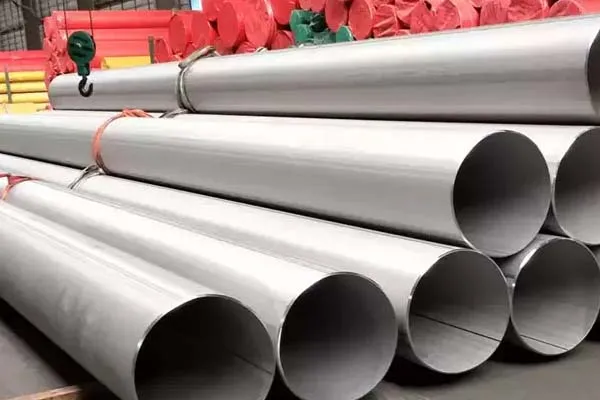
ERW and EFW Stainless Steel Pipes
Stainless Steel Pipe Industries & Applications
Stainless Steel pipes are found in 6 primary industrial sectors, including chemical & petrochemical processing, oil and gas, food, beverage, & pharmaceutical, water treatment & desalination, power generation, and architecture & construction.
Chemical & Petrochemical Processing
Reactor piping, transfer lines, and heat exchangers depend on 316L, 317L, or 904L, based on acid type and chloride levels.
Oil & Gas Industry
Offshore platforms, refinery process lines, and subsea flowlines use grades 316L and duplex variants for hydrogen sulphide resistance.
Food, Beverage & Pharmaceutical
Grades 304L and 316L with polished internal surfaces have hygienic piping standards required for dairy and pharmaceutical processing.
Water Treatment & Desalination
Grades 316L and 254 SMO handle RO plant membranes and seawater intake systems.
Power Generation
Steam lines, superheater sections, and flue gas ducting at sustained high temperatures generally use grades 321, 347, and 310S.
Architecture & Construction
Stainless steel square pipes and round pipes in grade 304 are found in handrails, facades, and structural frameworks in commercial buildings.
Stainless Steel Pipe vs Stainless Steel Tube
The table given below shows the comparison between stainless steel pipe and stainless steel tube.
| Parameter | Stainless Steel Pipes | Stainless Steel Tubes |
|---|---|---|
| Primary Use | Fluid transport (liquids, gases, process media) | Heat exchangers, instrumentation, precision applications |
| Dimension Standard | Specified by NPS (Nominal Pipe Size) | Specified by exact OD (Outer Diameter) |
| Wall Thickness | Defined by schedule (SCH 5, 10, 40, etc.) | Defined by precise wall thickness |
| Tolerance Level | Relatively broader tolerances | Tight dimensional tolerances |
| Manufacturing Focus | Flow capacity and pressure handling | Accuracy, surface finish, and consistency |
| Applicable Standards | ASTM A312 | ASTM A269 / ASTM A213 |
| Typical Industries | Oil & gas, chemical processing, water systems | Heat exchangers, condensers, instrumentation, pharmaceuticals |
Shipping & Packaging
 Heavy-duty wooden boxes Packing
We strictly follow seaworthy export handling standards to protect stainless steel pipe from transit damage, moisture ingress, and surface contamination during long-distance dispatch.
- Heavy-duty wooden boxes with moisture barrier lining
- HDPE stretch film wrapping on all bundles
- Plastic end caps on threaded and plain-end pipes
- Silica gel desiccants to minimize moisture exposure
- ISPM-15 fumigated wooden packaging for export
 Pipe Bundle Yard Staging
 Container End-Cap Protection
 Wrapped Export-Ready Bundles
We Export Worldwide
Sachiya Steel International supplies stainless steel products to major industrial markets across North America, Europe, the Middle East, Asia and Africa with export-ready documentation and logistics support.
 USA
USA Canada
 Germany
 UK
UK Italy
Italy France
 Australia
 South Korea
 Indonesia
 Vietnam
 Singapore
 Malaysia
 Taiwan
 UAE
UAE Saudi Arabia
 Qatar
Qatar Oman
Oman
 South Africa
 Nigeria
 Egypt
Egypt