





Specifications of Super Duplex 2507 Plate
Super duplex 2507 plate specifications, covering standards, forms, dimensions, finishes, and more, are provided in the table below:
| Parameter | Specification |
|---|---|
| Standard | ASTM A240 / ASME SA240 |
| Product Form | Plate, Sheet, Coil |
| Thickness Range | 3 mm – 150 mm |
| Width Range | Up to 3000 mm |
| Length Range | Up to 12000 mm |
| Surface Finishes | No.1, 2B, BA, No.4 |
| Forming Process | Hot Rolled / Cold Rolled |
Super Duplex 2507 Plate Sizes & Dimensions
Super Duplex 2507 Plate is available in many dimensional ranges to suit most project requirements. We stock standard mill sizes and also supply cut-to-size plates.
Standard Plate Thickness Range
The following standard SDSS 2507 plate thicknesses are available.
| Parameter | Specification |
|---|---|
| Thickness Range | 3 mm – 150 mm (0.188" – 6") |
| Classification Note | Below 3 mm classified as sheet |
| Standard Stock Range | 6 mm – 80 mm |
| Availability Outside Range | Available on mill order |
Standard Plate Width & Length
Super duplex 2507 plate is available in the following widths and lengths.
| Parameter | Specification |
|---|---|
| Width Range | Up to 3,000 mm (120") |
| Length Range | Up to 12,000 mm (480") |
| Standard Stock Widths | 1,000 mm, 1,250 mm, 1,500 mm, 2,000 mm |
| Custom Sizes | Available on request |
Super Duplex 2507 Plate Surface Finishes
Super Duplex 2507 Plate is supplied in the following 4 forms, with the solution-annealed condition being standard per ASTM A240.
- No. 1
- 2B
- 2D
- #4 (brushed)
Super Duplex 2507 Plate Price
Super Duplex 2507 Plate price in India starts from ₹600 and goes up to ₹1,500 per kg or $7–$18+ USD/kg. Final pricing depends on plate thickness, width and length, order quantity, surface finish, and any additional certification or testing requirements. Nickel and molybdenum prices directly influence raw material costs, and 2507's higher alloy content makes it more expensive than standard Duplex 2205 plate. Contact our sales team with your dimensions, quantity, and specification requirements for a current quotation.
Chemical Composition of Super Duplex 2507 Plate
The table below lists the chemical composition of Super Duplex 2507 Plate per ASTM A240. Chromium and molybdenum resist pitting and crevice attack in chloride media. Nitrogen strengthens the austenite phase while also raising the PREN value. The low-carbon content reduces the risk of intergranular corrosion in heat-affected zones after welding.
Mechanical Properties of Super Duplex 2507 Plate
ASTM A240 Grade 2507 plate provides mechanical performance that suits structural and pressure-containing applications.
| Property | Imperial | Metric |
|---|---|---|
| Tensile Strength, min | 116 ksi | 800 MPa |
| Yield Strength (0.2% offset), min | 80 ksi | 550 MPa |
| Elongation, min | 15% | 15% |
Equivalent Designations of Super Duplex 2507 Plates
International equivalents across various regions, including EN, UNS, and more, for SDSS 2507 plates are listed below.
| Standard | Designation |
|---|---|
| UNS | S32750 |
| EN 10088 | 1.4410 / X2CrNiMoN25-7-4 |
| GB/T 20878 | 022Cr25Ni7Mo4N |
Corrosion Resistance of Super Duplex 2507 Plate
Super Duplex 2507 Plate has a PREN value exceeding 40, providing outstanding resistance to chloride pitting, crevice corrosion, and stress corrosion cracking. 2 specific corrosion mechanisms relevant to plate selection are covered below.
-
Pitting & Crevice Corrosion Resistance
Super Duplex 2507 Plate resists pitting initiation in chloride-containing solutions at temperatures well above those tolerated by austenitic grades. The critical pitting temperature (CPT) in ferric chloride testing ranges between 70–85°C, depending on product form and test conditions. Crevice corrosion resistance follows a similar pattern. The high molybdenum and nitrogen content stabilises the passive film within tight geometries.
-
Stress Corrosion Cracking Resistance
The duplex microstructure of 2507 plate provides inherent resistance to chloride stress corrosion cracking (SCC). Austenitic stainless steels are susceptible to SCC at temperatures as low as 60 0C in concentrated chloride solutions. Alloy 2507's ferrite phase interrupts crack propagation paths, and the balanced 50/50 austenite-ferrite structure maintains this protection across a broad temperature range. This makes the plate suitable for sour service environments when supplied in solution-annealed condition, depending on hardness limits, heat treatment conditions, and application environment.
Super Duplex 2507 Plate Applications
Super Duplex 2507 Plate is specified in industries that demand high mechanical strength combined with exceptional corrosion resistance. The 4 primary application sectors are given below.
Oil & Gas Industry
2507 super duplex plate is used for subsea manifolds, topside process equipment, and pressure vessels on offshore platforms exposed to chloride-rich produced water.
Chemical Processing
Alloy 2507 plate serves in reactor vessels, heat exchangers, and piping systems handling sulphuric acid, phosphoric acid, and chloride-bearing chemical streams.
Desalination & Water Treatment
Super Duplex Steel 2507 Plate is fitted in high-pressure reverse osmosis frames, seawater intake structures, and brine handling systems where chloride concentrations are elevated.
Marine & Offshore Structures
The plate is specified for structural members, splash-zone cladding, and firewater system components on marine platforms and coastal installations.
Super Duplex 2507 Plate vs Duplex 2205 Plate
Super Duplex 2507 Plate and Duplex 2205 Plate are the two most specified duplex stainless steel plate grades. The comparison below shows the key differences between Super Duplex 2507 plate and Duplex 2205 plate.
| Property | Super Duplex 2507 (UNS S32750) | Duplex 2205 (UNS S31803) |
|---|---|---|
| UNS Designation | S32750 | S31803 / S32205 |
| EN Designation | 1.4410 | 1.4462 |
| Chromium (%) | 24.0 to 26.0 | 22.0 to 23.0 |
| Molybdenum (%) | 3.0 to 5.0 | 3.0 to 3.5 |
| Yield Strength, min | 80 ksi (550 MPa) | 65 ksi (450 MPa) |
| Tensile Strength, min | 116 ksi (800 MPa) | 90 ksi (620 MPa) |
| PREN | >40 | ~35 |
| Chloride SCC Resistance | Superior | Good |
Shipping & Packaging
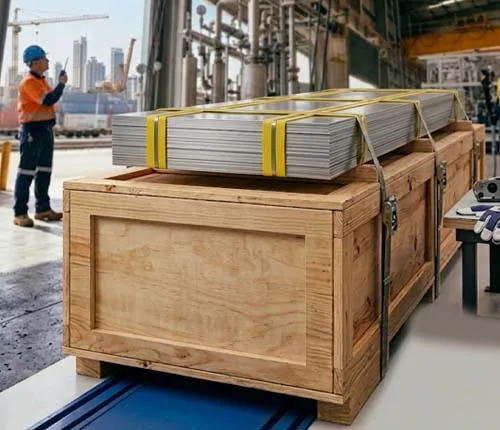 Heavy-duty wooden boxes Packing
We strictly follow seaworthy export handling standards to protect super duplex 2507 plate from transit damage, moisture ingress, and surface contamination during long-distance dispatch.
- Heavy-duty wooden boxes with moisture barrier lining
- HDPE stretch film wrapping on all bundles
- Edge and corner protection with plastic padding
- Silica gel desiccants to minimize moisture exposure
- ISPM-15 fumigated wooden packaging for export
 Plate Bundle Yard Staging
 Plate Bundle Edge Protection
 Wrapped Export-Ready Bundles
We Export Worldwide
Sachiya Steel International supplies super duplex steel products to major industrial markets across North America, Europe, the Middle East, Asia and Africa with export-ready documentation and logistics support.
 USA
USA Canada
 Germany
 UK
UK Italy
Italy France
 Australia
 South Korea
 Indonesia
 Vietnam
 Singapore
 Malaysia
 Taiwan
 UAE
UAE Saudi Arabia
 Qatar
Qatar Oman
Oman
 South Africa
 Nigeria
 Egypt
Egypt