




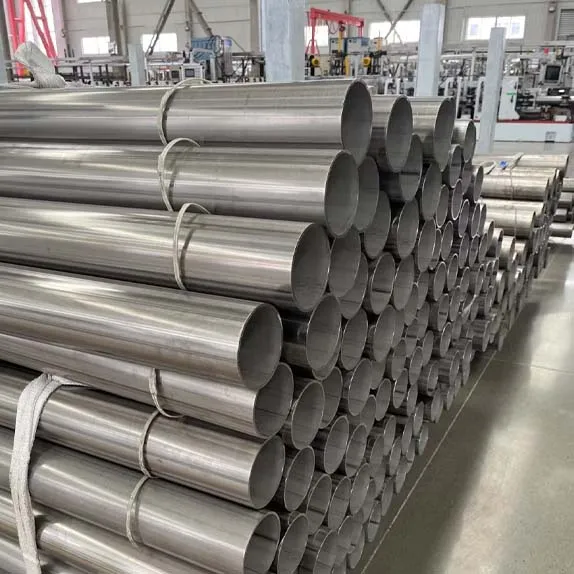
304 Stainless Steel Pipe Specifications
Stainless steel pipe specifications, including size range, length and dimensions, are listed in the table below:
| Parameter | Details |
|---|---|
| Standards | ASTM A312, ASME SA312 |
| Dimensions | ASME B36.10M, ASME B36.19M |
| Size Range | 1/8″ to 24″ (DN6–DN1200) |
| Wall Thickness | SCH 5S, 10S, 40S, 80S, 160, XXS |
| Length | Single Random (SRL), Double Random (DRL), 6 m, 12 m, custom lengths |
| End Type | Plain End (PE), Bevelled End (BE), Threaded |
| Surface Finish | Pickled, Annealed, Bright Annealed, Polished, Mirror, Passivated |
| Form | Seamless, Welded (ERW, EFW, HFW) |
304 Stainless Steel Pipe Sizes and Dimensions
This table explains the main size ranges, wall thickness schedules, and length options for 304 stainless steel pipes used in different industrial applications.
| Parameter | Specification |
|---|---|
| Size Range | NPS 1/8" to 24" and larger |
| Available Schedules | 5S, 10S, 40S, 80S |
| Common Schedules | 10, 40, 80 |
| Standard Length | 20 ft (6 metres) random |
| Custom Length | Cut-to-length available on request |
Schedule 10 Pipe Dimensions
Schedule 10 (10S) stainless steel 304 pipe has the thinnest wall of the standard schedules. It's intended for low-pressure service, drainage, and applications where weight reduction matters. The table below covers representative NPS sizes with OD, wall thickness, and weight.
| NPS | OD (in) | Wall Thickness (in) | Approx. Weight (lb/ft) |
|---|---|---|---|
| 1/2" | 0.840 | 0.083 | 0.67 |
| 3/4" | 1.050 | 0.083 | 0.86 |
| 1" | 1.315 | 0.109 | 1.40 |
| 1-1/2" | 1.900 | 0.109 | 2.09 |
| 2" | 2.375 | 0.109 | 2.64 |
| 3" | 3.500 | 0.120 | 4.33 |
| 4" | 4.500 | 0.120 | 5.61 |
Schedule 40 Pipe Dimensions
Schedule 40 (40S) is the most common wall thickness for 304 stainless steel pipe. It is used for general piping, structural supports, and medium-pressure systems in many industries. Its standard sizes are set by ASME B36.19M.
| NPS | OD (in) | Wall Thickness (in) | Approx. Weight (lb/ft) |
|---|---|---|---|
| 1/2" | 0.840 | 0.109 | 0.86 |
| 3/4" | 1.050 | 0.113 | 1.14 |
| 1" | 1.315 | 0.133 | 1.68 |
| 1-1/2" | 1.900 | 0.145 | 2.72 |
| 2" | 2.375 | 0.154 | 3.65 |
| 3" | 3.500 | 0.216 | 7.58 |
| 4" | 4.500 | 0.237 | 10.79 |
Schedule 80 Pipe Dimensions
Schedule 80 (80S) 304 stainless steel pipe has a thicker wall and is used for high-pressure, steam lines, and tough industrial conditions. The increased wall thickness allows the pipe to withstand higher pressure, but it also adds weight and raises the cost per metre.
| NPS | OD (in) | Wall Thickness (in) | Approx. Weight (lb/ft) |
|---|---|---|---|
| 1/2" | 0.840 | 0.147 | 1.09 |
| 3/4" | 1.050 | 0.154 | 1.47 |
| 1" | 1.315 | 0.179 | 2.17 |
| 1-1/2" | 1.900 | 0.200 | 3.63 |
| 2" | 2.375 | 0.218 | 5.02 |
| 3" | 3.500 | 0.300 | 10.25 |
| 4" | 4.500 | 0.337 | 14.98 |
304 Stainless Steel Pipe Weight Per Metre
304 stainless steel pipe weight depends on outside diameter (OD), wall thickness, and schedule. The standard formula for calculating pipe weight is:
Weight (kg/m) = (OD mm - Wall Thickness mm) x Wall Thickness mm x 0.02491
As an example, a 2" Schedule 40 pipe has a 60.3 mm outside diameter and a wall thickness of 3.91 mm. When you apply the formula, the resulting weight is roughly 5.44 kg per metre. Engineers, buyers, and project planners rely on these weight values to estimate shipping costs, verify how much load a structure can safely carry, and plan the amount of material they need. For other pipe schedules, use the same formula but substitute the appropriate wall thickness value.
The following table provides calculated weights for common 304 SS pipe sizes in Schedule 40.
| NPS | OD (mm) | Wall (mm) | Weight (kg/m) |
|---|---|---|---|
| 1/2" | 21.3 | 2.77 | 1.28 |
| 3/4" | 26.7 | 2.87 | 1.70 |
| 1" | 33.4 | 3.38 | 2.50 |
| 1-1/2" | 48.3 | 3.68 | 4.05 |
| 2" | 60.3 | 3.91 | 5.44 |
| 3" | 88.9 | 5.49 | 11.29 |
| 4" | 114.3 | 6.02 | 16.07 |
304 Stainless Steel Pipe Pressure Rating
The pressure rating of 304 stainless steel pipes depends on the schedule, pipe size, and temperature. For example, a 2" Schedule 40 pipe can handle about 2,220 psi at room temperature, according to ASME B31.3.
The table below presents approximate pressure ratings for selected sizes across 3 schedules at ambient temperature (38 degrees Celsius / 100 degrees Fahrenheit).
| NPS | Schedule 10 (psi) | Schedule 40 (psi) | Schedule 80 (psi) |
|---|---|---|---|
| 1/2" | 1,440 | 2,960 | 4,760 |
| 1" | 1,170 | 2,360 | 3,640 |
| 2" | 680 | 2,220 | 3,100 |
| 3" | 510 | 1,690 | 2,480 |
| 4" | 400 | 1,440 | 2,120 |
304 Stainless Steel Pipe Price
304 stainless steel pipe usually costs about INR 192 to 500 per kg in India, or around $3 to $12 per foot in the US. Seamless pipes are more expensive than welded pipes because they are harder to manufacture.
Several factors affect the final price of SS 304 pipe:
- Pipe size and wall thickness: Larger diameters and heavier schedules cost more per unit length
- Manufacturing type: Seamless pipe is 20 to 40% more expensive than welded pipe
- Surface finish: Polished or bright-annealed finishes add to the base cost
- Order quantity: Bulk orders typically attract better per-unit pricing
- Mill brand: Established mills command higher prices than secondary brands
- Market conditions: Raw material costs for nickel and chromium change regularly
Sachiya Steel International provides cost-effective pricing for every pipe size, schedule, and type. We handle everything from small trial orders to large-scale project needs. Send us your specifications to receive updated pricing and delivery information.
Chemical Composition of 304 Stainless Steel Pipe
The table below lists elements specified under ASTM A312 / ASME SA-312 for Grade TP304 (UNS S30400).
Chromium forms a protective layer, nickel improves toughness, low carbon prevents weld defects, and nitrogen contributes to pitting resistance and strength in stainless steel pipe.
Grade 304 can't be hardened by heat treatment. Strength increases are achieved through cold working instead, which is particularly relevant for heavily cold-worked pipe supplied under the same ASTM A312 standard.
Mechanical Properties of 304 Stainless Steel Pipe
The mechanical properties of 304 Stainless Steel pipe, including tensile strength, elongation and yield strength, are listed below:
The 35% elongation value proves that 304 SS pipe can withstand considerable deformation before fracture. This makes it an excellent choice for bending, flaring, and expanding operations during field installation. Cold working will raise tensile and yield strength but reduce elongation.
| Property | Imperial | Metric |
|---|---|---|
| Tensile Strength (min) | 75 ksi | 515 MPa |
| Yield Strength (min) | 30 ksi | 205 MPa |
| Elongation (min) | 35% | 35% |
Equivalent Designation of 304 Stainless Steel Pipe
Global equivalents of 304 stainless steel pipe, including UNS, AFNOR, Werkstoff, JIS, EN, GOST, and BS designations, are listed below:
| Standard | Equivalent Grade |
|---|---|
| Grade | SS 304 |
| UNS | S30400 |
| AFNOR | Z7CN18-09 |
| Werkstoff Nr. | 1.4301 |
| JIS | SUS 304 |
| EN | X5CrNi18-10 |
| GOST | 08X18H10 |
| BS | 304S31 |
304 Stainless Steel Pipe Industrial Applications
The sections below cover 4 specific application areas where 304 pipe delivers proven performance in resisting corrosion and delivering high-performance.
Food & Beverage Processing
Dairy plants, breweries, and food factories use 304 stainless steel pipe for product lines, CIP (clean-in-place) systems, and storage tank piping.
Chemical & Petrochemical Industry
In chemical and petrochemical plants, 304 SS pipe carries weak acids, alkalis, and organic solvents and serves in heat exchangers, condensate lines, and low‑chloride process piping.
Architectural & Structural Applications
Architects and fabricators select 304 stainless steel pipe for handrails, balustrades, canopies, curtain wall supports, and decorative frameworks.
Exhaust Systems
Automotive and industrial exhaust systems benefit from 304 pipe's resistance in intermittent service.
304 vs 316 Stainless Steel Pipe
304 stainless steel performs well in most general environments. The main difference is that 316 contains 2 to 3% molybdenum, which provides superior resistance to chlorides and marine atmospheres. Buyers choosing between the two grades should consider the following comparison.
| Property | 304 SS Pipe | 316 SS Pipe |
|---|---|---|
| Chromium Content | 18.0 to 20.0% | 16.0 to 18.0% |
| Nickel Content | 8.0 to 11.0% | 10.0 to 14.0% |
| Molybdenum | None | 2.0 to 3.0% |
| Chloride Resistance | Moderate | High |
| Cost (relative) | Lower | Higher (approx. 20 to 30% premium) |
| Tensile Strength (min) | 515 MPa | 515 MPa |
| Common Applications | Food processing, freshwater, and general chemical | Marine, saltwater, chloride-rich chemical |
Use 304 stainless steel pipe for food processing, freshwater systems, mild chemicals, and architectural work. Choose 316 stainless steel pipe for saltwater, brackish water, chloride-containing chemicals, or coastal environments. Since both have the same minimum tensile strength, base your choice mainly on how corrosive the environment is, not on how much load the pipe must carry.
Shipping & Packaging
 Heavy-duty wooden boxes Packing
We strictly follow seaworthy export handling standards to protect 304 pipe from transit damage, moisture ingress, and surface contamination during long-distance dispatch.
- Heavy-duty wooden boxes with moisture barrier lining
- HDPE stretch film wrapping on all bundles
- Plastic end caps on threaded and plain-end pipes
- Silica gel desiccants to minimize moisture exposure
- ISPM-15 fumigated wooden packaging for export
 Pipe Bundle Yard Staging
 Container End-Cap Protection
 Wrapped Export-Ready Bundles
We Export Worldwide
Sachiya Steel International supplies stainless steel products to major industrial markets across North America, Europe, the Middle East, Asia and Africa with export-ready documentation and logistics support.
 USA
USA Canada
 Germany
 UK
UK Italy
Italy France
 Australia
 South Korea
 Indonesia
 Vietnam
 Singapore
 Malaysia
 Taiwan
 UAE
UAE Saudi Arabia
 Qatar
Qatar Oman
Oman
 South Africa
 Nigeria
 Egypt
Egypt