




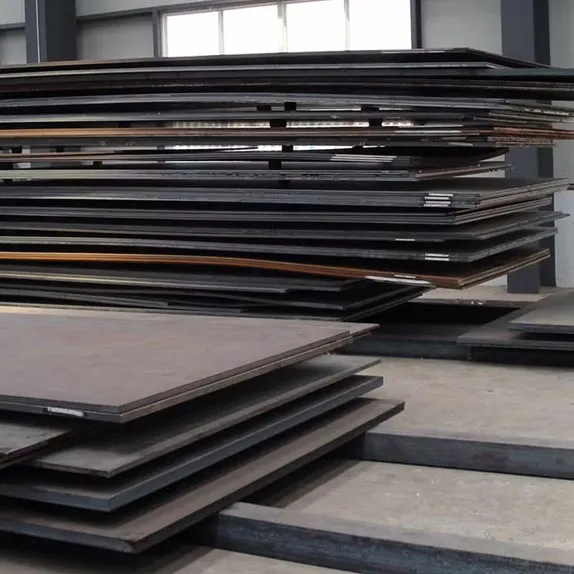
ASTM A387 Gr.5 Plate Specifications
The table below outlines ASTM A387 Gr.5 plate key supply and specification parameters.
| Parameter | Details |
|---|---|
| Standard | ASTM A387 / ASME SA-387 |
| Class | Class 1, Class 2 |
| Thickness Range | 6 mm to 300 mm |
| Width Range | 3000 mm |
| Length Range | 12000 mm |
| Delivery Condition | Normalised, Normalised & Tempered, Quenched & Tempered |
| Surface Finish | Hot Rolled, Sandblasted, Mill Finish |
Available Sizes of ASTM A387 Gr.5 Plates
ASTM A387 Grade 5 alloy steel plates are stocked in standard mill sizes and can be supplied cut-to-size for specific project requirements. The following ranges are typically available.
| Dimension | Range |
|---|---|
| Thickness | 6 mm to 150 mm (1/4" to 6") |
| Width | Up to 3000 mm (up to 120") |
| Length | Up to 12000 mm (up to 480") |
| Custom sizes | Cut-to-size available on request |
ASTM A387 Gr.5 Plate Price
ASTM A387 Grade 5 usually costs between ₹100 and ₹150 per kg in India, with lower prices available for large bulk orders. In international markets, prices are generally between USD $1.20 and $2.50 per kg, depending on the plate thickness, class, and country of origin. Class 2 plates are costlier than Class 1 plates because they require additional heat treatment. The final price is also affected by the mill where the plate is produced, the size of the order, the heat treatment condition, and the testing requirements.
ASTM A387 Gr.5 Plate Chemical Composition
The table below lists the full chemical composition of A387 Grade 5 plates as specified by the standard.
The high chromium range separates Grade 5 from lower-chromium A387 grades. It forms a stable oxide layer that resists sulfidation and high-temperature oxidation in refinery and petrochemical service.
ASTM A387 Gr.5 Plate Mechanical Properties
ASTM A387 Grade 5 plates come in two classes. Class 1 has lower strength for moderate use, while Class 2 has higher strength for tougher conditions. Both have the same chemistry; only the heat treatment and resulting strength differ.
Class 1 Mechanical Properties
Class 1 properties work well for pressure vessel parts that need lower hardness and easier machining. The values below show the minimum levels required by ASTM A387.
| Property | Value |
|---|---|
| Tensile Strength | 415 to 585 MPa (60 to 85 ksi) |
| Yield Strength (0.2% offset) | 205 MPa min (30 ksi) |
| Elongation in 200 mm | 22% min |
| Elongation in 50 mm | 18% min |
Class 2 Mechanical Properties
Class 2 plates are specified for higher-pressure or more demanding designs. They require more controlled normalising and tempering to achieve the elevated strength values.
| Property | Value |
|---|---|
| Tensile Strength | 485 to 655 MPa (70 to 95 ksi) |
| Yield Strength (0.2% offset) | 310 MPa min (45 ksi) |
| Elongation in 50 mm | 18% min |
ASTM A387 Gr.5 Plate Equivalent Designations
Buyers procuring UNS K41545 across different national standards can cross-reference using the table below.
| Standard / System | Designation |
|---|---|
| UNS (USA) | K41545 |
| EN / DIN (Europe) | X12CrMo5 |
| Werkstoff Nr. | 1.7362 |
| JIS (Japan) | G4109 SCMV 5 |
ASTM A387 Gr.5 Plate Applications
ASTM A387 Grade 5 plates are used in equipment that must safely hold pressure at high temperatures. Their 5Cr-0.5Mo alloy gives them strong resistance to hydrogen damage and sulfur attack, so they perform well in hot and corrosive conditions.
Petroleum Refining & Petrochemical Industry
A387 Grade 5 plates are used in catalytic cracking units, hydroprocessing reactors and desulfurisation vessels. The 5% chromium content resists sulfur compound attack at temperatures where lower-chromium grades would corrode rapidly.
Power Generation
Cr-Mo plates in this grade serve as components in high-temperature boiler drums, heat recovery steam generators (HRSGs), and superheater headers. The alloy maintains its creep strength through prolonged thermal cycling.
Chemical Processing
Chemical reactor vessels handling hydrogen-rich streams at elevated temperatures rely on 5Cr-0.5Mo plates. They resist hydrogen attack, where carbon steel and low-chromium alloys become susceptible to decarburisation.
ASTM A387 Gr.5 vs. Other A387 Grades
The comparison below covers the three grades most commonly evaluated alongside ASTM A387 Gr.5: Grade 11, Grade 22 and Grade 9. Grade 5 (5Cr-0.5Mo) sits in the middle of the A387 chromium-molybdenum family. Grade selection depends on operating temperature, corrosion environment and hydrogen partial pressure.
ASTM A387 Gr.5 vs. Gr.11 (1.25Cr-0.5Mo)
ASTM A387 Grade 5 and ASTM A387 Grade 11 plates mainly differ in chromium content, which affects the temperature ranges they can handle and their resistance to sulfidation.
| Property | ASTM A387 Gr.5 | ASTM A387 Gr.11 |
|---|---|---|
| Chromium Content | 4.00 – 6.00% | 1.25% |
| Molybdenum Content | 0.45 – 0.65% | 0.45 – 0.65% |
| Temperature Resistance | Above 450°C | Up to 400°C |
| Sulfidation Resistance | High (preferred for high-temp service) | Moderate |
| Typical Application | Refinery hydroprocessing equipment | Moderate sulfur, lower temp service |
| Cost | Higher (premium alloy) | More economical |
| Preferred Service | High-temp, high-sulfur environments | Services below 400°C (750°F) |
ASTM A387 Gr.5 vs. Gr.22 (2.25Cr-1Mo)
ASTM A387 Grade 22 plates and A387 Grade 5 have very different chromium levels. This affects how well they resist oxidation, how easy they are to fabricate, the temperatures they can handle in service, and their overall cost.
| Property | ASTM A387 Gr.5 | ASTM A387 Gr.22 |
|---|---|---|
| Chromium Content | 4.00 – 6.00% | 2.25% |
| Molybdenum Content | 0.45 – 0.65% | 1.00% |
| Sulfidation Resistance | Higher (due to more chromium) | Moderate |
| Creep Rupture Properties | Moderate | Slightly better (higher molybdenum) |
| Primary Strength | Corrosion & oxidation resistance | High-temperature creep strength |
| Typical Application | Refinery & petrochemical equipment | Power generation pressure vessels |
| Usage | Less common than Gr.22 | One of the most widely used Cr-Mo grades |
| Best Chosen When | Corrosion resistance is a priority | High-temperature strength is a priority |
ASTM A387 Gr.5 vs. Gr.9 (9Cr-1Mo)
ASTM A387 Grade 5 and ASTM A387 Grade 9 plates vary significantly in chromium content, influencing their oxidation resistance, fabricability, service temperature range and overall cost.
| Property | ASTM A387 Gr.5 | ASTM A387 Gr.9 |
|---|---|---|
| Chromium Content | 4.00 – 6.00% | 9.00% |
| Molybdenum Content | 0.45 – 0.65% | 0.90 – 1.10% |
| Oxidation Resistance | Good | Superior |
| Sulfidation Resistance | Good | Higher (due to more chromium) |
| Typical Service Temperature | 450°C to 550°C | Above 550°C (1020°F) |
| Fabricability | Easier to fabricate | More challenging |
| Cost | Lower | Higher |
| Best Chosen When | Balanced performance & cost needed | Maximum oxidation & sulfidation resistance required |
Shipping & Packaging
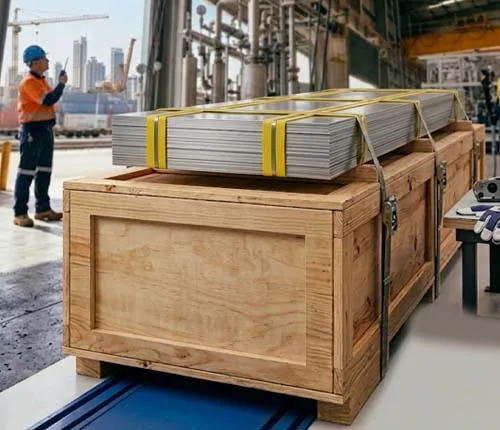 Heavy-duty wooden boxes Packing
We strictly follow seaworthy export handling standards to protect ASTM A387 Gr.5 Plates from transit damage, moisture ingress, and surface contamination during long-distance dispatch.
- Heavy-duty wooden boxes with moisture barrier lining
- HDPE stretch film wrapping on all bundles
- Plastic end caps on threaded and plain-end plate
- Silica gel desiccants to minimize moisture exposure
- ISPM-15 fumigated wooden packaging for export
 Plate Bundle Yard
Staging
Plate Bundle Yard
Staging
 Plate Bundle Edge Protection
 Wrapped Export-Ready
Bundles
Wrapped Export-Ready
Bundles
We Export Worldwide
Sachiya Steel International supplies Alloy Steel Products to major industrial markets across North America, Europe, the Middle East, Asia and Africa with export-ready documentation and logistics support.
 USA
USA Canada
 Germany
 UK
UK Italy
Italy France
 Australia
 South Korea
 Indonesia
 Vietnam
 Singapore
 Malaysia
 Taiwan
 UAE
UAE Saudi Arabia
 Qatar
Qatar Oman
Oman
 South Africa
 Nigeria
 Egypt
Egypt