




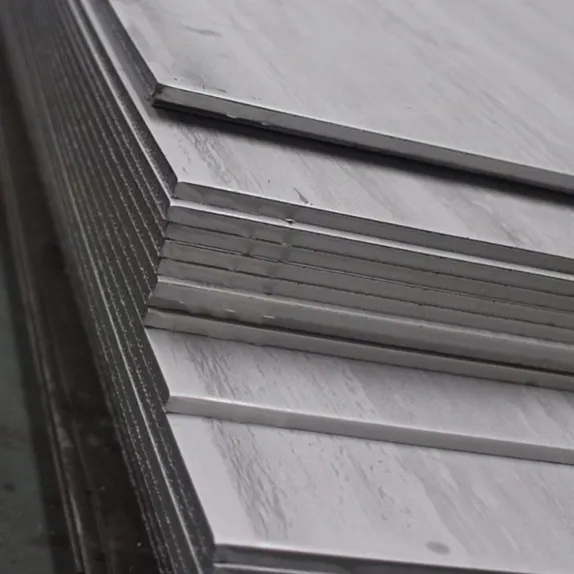
Specifications of Stainless Steel 321 Plates
The specifications of Stainless Steel 321 Plates, including standards, length and surface finish, are listed in the table below.
| Property | Details |
|---|---|
| Standards | ASTM A240 / ASME SA240 / EN 10088 / JIS G4304 |
| Size Range | Width: 1000 mm – 3000 mm Length: 2000 mm – 12000 mm |
| Length | Single Random, Double Random, Custom Cut Length |
| End Type | Mill Edge (ME), Slit Edge (SE) |
| Surface Finish | 2B, No.1 (Hot Rolled), No.4, BA, Mirror Finish |
| Form | Plates, Sheets, Coils, Shim Sheets, Foils |
Available Sizes of Stainless Steel 321 Plates
The available sizes of Stainless Steel 321 Plates are listed in the table given below.
| Parameter | Specification |
|---|---|
| Thickness Range | 3 mm (0.118") to 80 mm (3.0″) |
| Standard Widths | Up to 2500 mm (96″) |
| Standard Lengths | Up to 6000 mm (240″) |
| Common Plate Size | 48″ × 96″ (4’ × 8’) |
| Other Available Sizes | 36″ × 96″, 48″ × 120″, 50″ × 144″ |
| Custom Sizes | Available as per client specification (cut-to-size) |
Stainless Steel 321 Plates Price
In India, the price of SS 321 plates depends on thickness, size, quantity, finish, and grade, and is usually between ₹200 and ₹350 per kg. In the US market, prices range from approximately $4 to $7 per kilogram. AMS 5510-certified plates command a premium over standard ASTM A240 stock. Contact our sales team for a quotation.
Chemical Composition of Stainless Steel 321 Plates
The chemical composition of Stainless Steel 321 plates, along with their proportion in percentage, is listed below.
Mechanical Properties of Stainless Steel 321 Plates
The mechanical properties of Stainless Steel 321 Plates, including elongation and tensile strength, are listed below:
| Property | Value | Unit |
|---|---|---|
| Tensile Strength (min) | 515 / 75 | MPa / ksi |
| Yield Strength, 0.2% Offset (min) | 205 / 30 | MPa / ksi |
| Elongation in 2 in. (min) | 35 | % |
| Brinell Hardness (max) | 217 | HBW |
| Rockwell B Hardness (max) | 95 | HRB |
Equivalent Designations for Stainless Steel 321 Plates
International Designations equivalent to Stainless Steel 321 Plates, along with UNS and GOST, are listed in the table.
| Designation | Standard |
|---|---|
| S32100 | ASTM A240, ASME SA-240 |
| 1.4541 / X6CrNiTi18-10 | EN 10088-2 |
| SUS 321 | JIS G4304 |
| 06Cr18Ni11Ti / 0Cr18Ni10Ti | GB/T 3280 |
| 08Kh18N10T | GOST 5632 |
| Z6CNT18-10 | NF A35-572 |
| 321S31 | BS 1449 |
| SS2337 | SS Standard |
Stainless Steel 321 Plate Forms
Stainless Steel 321 plates are available in the following forms
- Hot-rolled annealed and pickled (HRAP)
- Cold-rolled forms.
- Finishes include No. 1, 2B, 2D, and No. 4 brushed.
- Chequered plates
- Perforated plates
- Shim plates
321 vs 321H Plates
Comparison of Stainless Steel 321 and 321H grades based on carbon content, strength, temperature performance, and typical industrial applications is given below.
| Parameter | SS 321 | SS 321H |
|---|---|---|
| Carbon Content | Max 0.08% | 0.04% – 0.10% |
| Primary Feature | Titanium-stabilised to resist intergranular corrosion | Higher carbon for improved high-temperature strength |
| Creep Strength | Moderate | Higher, especially above 540°C (1000°F) |
| Temperature Performance | Suitable for moderately elevated temperatures | Preferred for prolonged high-temperature service |
| Code Compliance | General applications | Commonly specified in ASME pressure vessel codes |
| Applications | Exhaust systems, heat exchangers, and welded structures | Boilers, pressure vessels, high-temp piping |
| Dual Certification | Possible when chemistry meets both ranges | Possible when chemistry meets both ranges |
Stainless Steel 321 Plates vs Stainless Steel 304 and Stainless Steel 316 Plates
Comparison of SS 304, 316, and 321 plates, focusing on their heat resistance, corrosion resistance, and performance in tough industrial conditions is given below.
| Property / Feature | SS 304 Plates | SS 316 Plates | SS 321 Plates |
|---|---|---|---|
| Alloying Elements | Chromium, Nickel | Chromium, Nickel, Molybdenum | Chromium, Nickel, Titanium |
| High-Temperature Performance | Moderate (up to ~500°C) | Moderate | Excellent (up to ~900°C continuous service) |
| Sensitisation Resistance | Prone after prolonged heating | Better than 304 | Excellent (titanium stabilised) |
| Intergranular Corrosion | Susceptible after welding/heat exposure | Resistant | Highly resistant |
| Chloride Resistance | Limited | Excellent (due to molybdenum) | Moderate |
| Thermal Cycling | Moderate performance | Moderate | Excellent |
| Oxidation Resistance | Good | Good | Superior at elevated temperatures |
| Best Use Case | General applications | Marine, chemical, chloride environments | High-temperature and heat-exposed applications |
| Cost | Most economical | Higher than 304 | Slightly higher than 304, similar to 316 |
Industrial Applications of Stainless Steel 321 Plates
SS 321 plates serve industries where prolonged heat exposure and post-weld integrity are critical. The 3 primary sectors are petrochemical, aerospace, and power generation.
Petrochemical and Refinery Applications
Refineries use 321 plates for heat exchanger baffles, expansion bellows, and catalyst support trays.
Aerospace and Exhaust System Applications
AMS 5510-certified SS 321 plates are specified for aircraft exhaust collectors, firewalls, and engine shrouds. Automotive exhaust manifolds also use this grade.
Power Generation and Furnace Applications
Furnace linings, stack liners, and radiant tube supports are common power-generation uses.
Shipping & Packaging
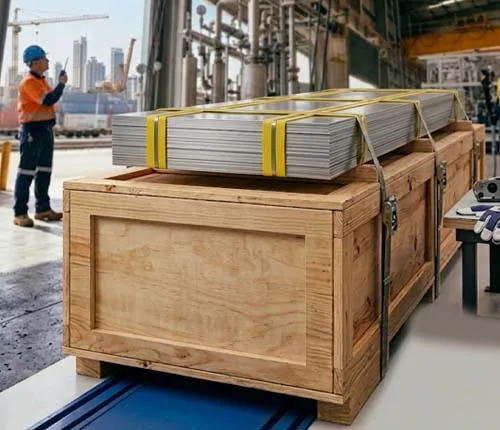 Heavy-duty wooden boxes Packing
We strictly follow seaworthy export handling standards to protect stainless steel 321 plates from transit damage, moisture ingress, and surface contamination during long-distance dispatch.
- Heavy-duty wooden boxes with moisture barrier lining
- HDPE stretch film wrapping on all bundles
- Edge and corner protection with plastic padding
- Silica gel desiccants to minimize moisture exposure
- ISPM-15 fumigated wooden packaging for export
 Plate Bundle Yard
Staging
Plate Bundle Yard
Staging
 Plate Bundle Edge
Protection
Plate Bundle Edge
Protection
 Wrapped Export-Ready
Bundles
Wrapped Export-Ready
Bundles
We Export Worldwide
Sachiya Steel International supplies stainless steel products to major industrial markets across North America, Europe, the Middle East, Asia and Africa with export-ready documentation and logistics support.
 USA
USA Canada
 Germany
 UK
UK Italy
Italy France
 Australia
 South Korea
 Indonesia
 Vietnam
 Singapore
 Malaysia
 Taiwan
 UAE
UAE Saudi Arabia
 Qatar
Qatar Oman
Oman
 South Africa
 Nigeria
 Egypt
Egypt