




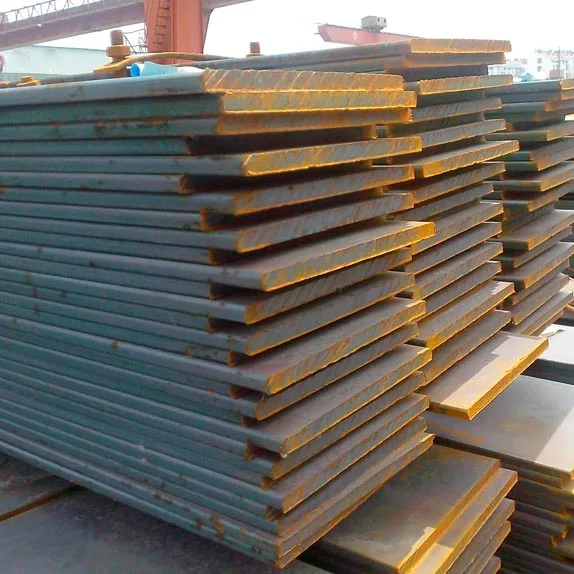
Specifications of ASTM A516 Gr. 70 Plate
The specifications of ASTM A516 Gr. 70 Plate, including size, surface finish and form is listed below.
| Parameter | Specification |
|---|---|
| Standards | ASTM A516 / ASME SA516 |
| Size Range | Width: 1000 mm to 4000 mm (custom sizes available) |
| Length | 2000 mm to 12000 mm (custom lengths available) |
| End Type | Mill Edge / Slit Edge |
| Surface Finish | Hot Rolled (HR), Shot Blasted, Pickled, Coated (as required) |
| Form | Plates, Sheets |
ASTM A516 Gr. 70 Plate Sizes and Dimensions
The size and dimensions available for ASTM A516 Gr. 70 plate are listed below in the table.
| Parameter | Typical Range |
|---|---|
| Thickness | 6 mm (1/4") to 200 mm (8") |
| Width | 1,200-3,050 mm (48"-120") |
| Length | Up to 12,192 mm (480") |
ASTM A516 Gr. 70 Plate Price
ASTM A516 Grade 70 plate pricing ranges from ₹52 to ₹80 per kg in India and $0.85 to $1.57 per kg, depending on thickness, width, length, quantity, and delivery condition (as-rolled or normalised). Additional testing requirements, such as HIC testing, Charpy impact testing, or ultrasonic examination, affect the final cost. Contact Sachiya Steel for current market pricing with mill test certification and full traceability.
ASTM A516 Grade 70 Chemical Composition
The chemical composition of ASTM A516 Grade 70 plate, with its proportions, is listed in the table below. Carbon limits increase with plate thickness per ASTM A516/A516M. For plates over 1/2" (12.7 mm), the maximum carbon content rises incrementally.
ASTM A516 Grade 70 Mechanical Properties
The mechanical properties of ASTM A516 Grade 70 plate, including elongation and yield strength, are listed below.
| Property | Value (Imperial) | Value (Metric) |
|---|---|---|
| Tensile Strength | 70-90 ksi | 485-620 MPa |
| Yield Strength (min) | 38 ksi | 260 MPa |
| Elongation in 8" (min) | 21% | 21% |
Equivalent International Standards
International designations equivalent to ASTM A516 Gr. 70 Plate have been provided in the table given below.
| Standard | Designation |
|---|---|
| EN 10028-2 | P355GH / 1.0473 |
| Indian Standard | IS 2041 Grade R260 |
| GB 713 | Q345R |
ASTM A516 Grade 70 Plate Industrial Applications
ASTM A516 Grade 70 plate is used in 3 primary industry sectors, as mentioned below.
Oil & Gas and Petrochemical
A516 Grade 70 plate is the standard choice for separator vessels, column shells, and reactor components in refinery and petrochemical facilities.
Power Generation
Boiler drums, steam headers, and economiser shells in thermal power plants are commonly fabricated from SA-516 Grade 70 plate.
Storage Tanks (API 650/620)
This grade is approved for shell and bottom plates in API 650 and API 620 welded storage tanks used for oil and low-pressure applications.
ASTM A516 Gr. 70 vs Gr. 60 Plate Comparison
This table compares ASTM A516 Grade 60 and Grade 70 based on strength, formability, and pressure vessel application.
| Property / Aspect | ASTM A516 Grade 60 | ASTM A516 Grade 70 |
|---|---|---|
| Tensile Strength | 60-80 ksi | 70-90 ksi |
| Yield Strength | 32 ksi | 38 ksi |
| Pressure Suitability | Lower-pressure applications | Higher-pressure applications |
| Formability | Slightly better (especially at lower thickness) | Moderate |
| Typical Use Case | General-purpose pressure vessels | High-strength pressure vessels |
| Selection Criteria | Based on lower pressure and easier fabrication | Based on higher pressure and strength requirements |
Shipping & Packaging
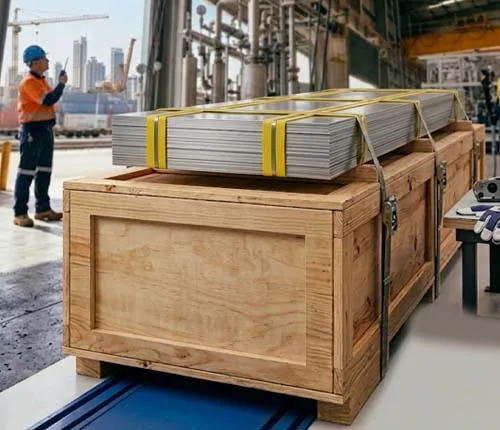 Heavy-duty wooden boxes Packing
We strictly follow seaworthy export handling standards to protect ASTM A516 Gr. 70 plate from transit damage, moisture ingress, and surface contamination during long-distance dispatch.
- Heavy-duty wooden boxes with moisture barrier lining
- HDPE stretch film wrapping on all bundles
- Plastic end caps on threaded and plain-end pipes
- Silica gel desiccants to minimize moisture exposure
- ISPM-15 fumigated wooden packaging for export
 plate Bundle Yard
Staging
plate Bundle Yard
Staging
 Bundle Edge Protection
 Wrapped Export-Ready
Bundles
Wrapped Export-Ready
Bundles
We Export Worldwide
Sachiya Steel International supplies Alloy steel products to major industrial markets across North America, Europe, the Middle East, Asia and Africa with export-ready documentation and logistics support.
 USA
USA Canada
 Germany
 UK
UK Italy
Italy France
 Australia
 South Korea
 Indonesia
 Vietnam
 Singapore
 Malaysia
 Taiwan
 UAE
UAE Saudi Arabia
 Qatar
Qatar Oman
Oman
 South Africa
 Nigeria
 Egypt
Egypt