




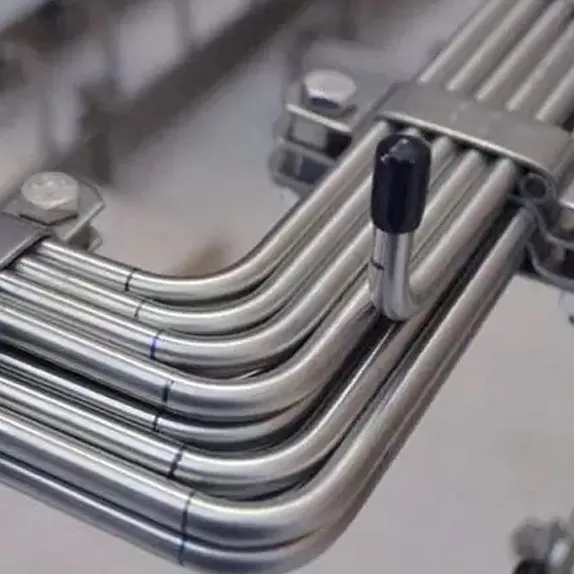
Stainless Steel Instrumentation Tubing Specification
Stainless steel instrumentation tubing meet international standards that govern dimensions, tolerances, and material properties. The table below lists core specifications for SS instrumentation tubes.
| Parameter | Details |
|---|---|
| Standards | ASTM A269 / ASME SA-269, ASTM A213 / ASME SA-213 |
| Grades | 304, 316 |
| OD Range | 1/8" to 1" (3.18 mm to 25.4 mm) |
| Wall Thickness | 0.028" to 0.120" (0.71 mm to 3.05 mm) |
| Length | 6 metres (20 feet) standard; coils available |
| Forms | Seamless, Welded and Drawn |
| Surface Finish | Bright Annealed (BA), Annealed and Pickled (AP), Mill Finish, Polished |
| End Type | Plain end, capped |
Stainless Steel Instrumentation Tube Sizes
SS instrumentation tubing comes in fractional sizes from 1/8" to 1" OD and metric sizes from 6 mm to 25 mm OD. Standard wall thicknesses range from 0.028" to 0.120" (0.71 mm to 3.05 mm). We supply tubing in 6-metre straight lengths and coils for smaller OD sizes.
Fractional Instrumentation Tube Sizes (Inches)
This table provides standard fractional OD sizes with common wall thickness options.
| OD (in.) | Wall Thickness Options (in.) |
|---|---|
| 1/8 | 0.028, 0.035 |
| 1/4 | 0.028, 0.035, 0.049 |
| 3/8 | 0.035, 0.049, 0.065 |
| 1/2 | 0.035, 0.049, 0.065, 0.083 |
| 3/4 | 0.049, 0.065, 0.083 |
| 1 | 0.049, 0.065, 0.083, 0.120 |
Metric Instrumentation Tube Sizes (mm)
Metric sizes serve international buyers who specify dimensions in millimetres.
| OD (mm) | Wall Thickness Options (mm) |
|---|---|
| 6 | 1.0 |
| 10 | 1.0, 1.5 |
| 12 | 1.0, 1.5, 2.0 |
| 16 | 1.5, 2.0 |
| 20 | 2.0 |
| 25 | 2.0 |
Instrumentation Tube Dimensions and Weight Chart
Weights are theoretical, worked out as (OD − wall) × wall × π × density at 8.0 g/cm³. Custom cut-to-length orders are accepted. Coiled tubing is typically available for OD sizes up to 1/2". Contact us with your project dimensions for weight calculations and delivery timelines.
| Outside Diameter (OD) | Wall Thickness | Approx. Weight (kg/m) |
|---|---|---|
| 1/8" (3.18 mm) | 0.028" (0.71 mm) | 0.04 kg/m |
| 1/4" (6.35 mm) | 0.035" (0.89 mm) | 0.12 kg/m |
| 3/8" (9.53 mm) | 0.049" (1.24 mm) | 0.26 kg/m |
| 1/2" (12.70 mm) | 0.065" (1.65 mm) | 0.46 kg/m |
| 3/4" (19.05 mm) | 0.083" (2.11 mm) | 0.90 kg/m |
| 1" (25.40 mm) | 0.109" (2.77 mm) | 1.58 kg/m |
Surface Finish Options
Stainless steel instrumentation tubing is supplied in the following finishes.
- Bright Annealed (BA)
- Annealed
- Pickled (AP)
- Mill Finish
- Mechanically Polished Conditions.
Stainless Steel Instrumentation Tube Price
Stainless steel instrumentation tube pricing is ₹200 to ₹650 per kilogram, roughly $2.35 to $7.65 per kg. Final pricing depends on grade, OD, wall thickness, quantity, and surface finish. 316 tubing costs 15 to 25% more than 304 equivalent sizes. Seamless tubing costs more than welded and drawn. Request a quote from us for current pricing based on your specifications and order quantity.
Applicable Standards for Instrumentation Tubes
The following table summarises the primary standards that cover SS instrumentation tubing in different tube types.
| Standard | ASME Equivalent | Tube Type |
|---|---|---|
| ASTM A213 | ASME SA-213 | Seamless |
| ASTM A269 | ASME SA-269 | Seamless and Welded |
Stainless Steel Instrumentation Tube Grades
The most common grades for SS instrumentation tubing are 304 and 316 austenitic stainless steels.
Grade 304 Instrumentation Tube
Grade 304 instrumentation tube contains 18.0 to 20.0% chromium and 8.0 to 11.0% nickel. Common applications include water treatment, food processing, and HVAC instrumentation.
Grade 316 Instrumentation Tube
The addition of 2.00 to 3.00% molybdenum sets 316 apart from 304. This element significantly improves pitting and crevice corrosion resistance in chloride-bearing media. Offshore oil and gas platforms, pharmaceutical plants, and marine environments all require Grade 316 instrumentation tube. The 15 to 25% price premium over 304 is justified where corrosion protection is critical.
Stainless Steel Instrumentation Tubing Forms
Stainless steel instrumentation tubing is produced in two forms: seamless, and welded and drawn. The choice between them depends on operating pressure, budget, and how critical the service is.
Stainless Steel Seamless Instrumentation Tubing
Made
by piercing and drawing a solid billet, so there is no weld seam. With no seam there is
no heat-affected zone to fail, which is why seamless is specified for higher pressures
and for critical service. It is supplied to ASTM A213 / ASME SA-213 and costs more than welded and drawn.
Stainless Steel Welded and Drawn Instrumentation Tubing
Formed from strip, seam-welded, then cold drawn over a mandrel. The draw works the weld until it is indistinguishable from the parent metal, which is what makes it suitable for compression fittings. Supplied to ASTM A269 / ASME SA-269, it gives tolerances close to seamless at a lower cost.
For compression-fitting service, specify seamless or welded and drawn. Tube fitting manufacturers call for fully annealed tubing no harder than 90 HRB, free of scratches, and holding its outside diameter tolerance along the whole length, the ferrule has to bite evenly right around the tube to seal.
Industrial Applications of Stainless Steel Instrumentation Tubes
Stainless steel instrumentation tubes are used in four major industries, as mentioned below.
Oil & Gas and Petrochemical
SS instrumentation tubing carries process signals from transmitters and gauges on offshore platforms, refineries, and gas processing plants.
Chemical Processing
Instrument tubing in chemical plants connects pressure sensors, level indicators, and flow meters to control rooms. Corrosion-resistant grades handle acid and alkali exposure.
Power Generation
Process instrumentation tubing monitors steam pressure and temperature in boilers and turbines.
Pharmaceutical and Food Processing
Bright annealed instrumentation tubing meets cleanliness requirements of pharmaceutical production and food-grade processing environments. Smooth internal surfaces prevent bacterial retention.
Stainless Steel Instrumentation Tube vs. Carbon Steel Tubing
The table below compares the SS instrumentation tube with carbon steel tubing in key performance factors.
| Property | Stainless Steel | Carbon Steel |
|---|---|---|
| Corrosion Resistance | High (Cr oxide layer) | Low (requires coating) |
| Service Life | 20+ years typical | 5 to 10 years in corrosive service |
| Maintenance | Minimal | Frequent inspection and replacement |
| Initial Cost | Higher | Lower |
| Cleanliness | BA finish available | Not available |
Shipping & Packaging
 Heavy-Duty Wooden Box Packing
Instrumentation tube ships in capped, film-wrapped bundles inside lined wooden cases. A scratched surface will not seal in a compression fitting, so the wrap stays on.
- Heavy-duty wooden boxes or strapped bundles, with moisture barrier lining
- LLDPE stretch film wrapping on all bundles
- Plastic end caps on plain, bevelled and threaded ends
- Silica gel desiccants to minimise moisture exposure
- ISPM-15 compliant wooden packaging for export
 Tube Bundle Yard
Staging
 Tube End-Cap Protection
 Wrapped Export-Ready
Bundles
We Export Worldwide
Sachiya Steel International supplies stainless steel products to major industrial markets across North America, Europe, the Middle East, Asia and Africa with export-ready documentation and logistics support.
 USA
 Canada
 Germany
 UK
 Italy
 France
 Australia
 South Korea
 Indonesia
 Vietnam
 Singapore
 Malaysia
 Taiwan
 UAE
 Saudi Arabia
 Qatar
 Oman
 South Africa
 Nigeria
 Egypt
