





ASTM A387 Gr.11 Plate Specifications
ASTM A387 / ASME SA-387 Grade 11 plates are supplied in hot-rolled, normalised and tempered condition. The table below covers key specification details for procurement.
| Parameter | Details |
|---|---|
| Standard | ASTM A387 / ASME SA-387 |
| Form | Hot Rolled Plate |
| Thickness | 5 mm – 150 mm (0.20 in – 5.90 in) |
| Width | Up to 4,500 mm (177 in) |
| Length | Up to 18,000 mm (708 in) |
| Surface Finish | Hot Rolled, Descaled |
| Heat Treatment | Normalised and Tempered / Annealed |
| Testing | UT per ASTM A435/A577/A578 available on request |
Available Sizes of ASTM A387 Grade 11 Plates
Standard sizes of ASTM A387 Gr.11 plates are available. You can request CNC, plasma, or profile-cut custom sizes.
| Dimension | Range |
|---|---|
| Thickness | 5 mm – 150 mm (0.20 in – 5.90 in) |
| Width | 500 mm – 4,500 mm (20 in – 177 in) |
| Length | 3,000 mm – 18,000 mm (118 in – 708 in) |
For plates outside these ranges or specific cut-to-size requirements, contact our sales team with your project drawings.
ASTM A387 Gr.11 Plates Price
The starting price in India is approximately ₹105/kg, which equates to USD $0.80–$1.20 per kg on a global scale. Thickness, class, and testing requirements drive ASTM A387 Grade 11 alloy steel plate prices. The final costs are contingent upon market conditions, ultrasonic testing, and thermal treatment. The total quote we provide is also influenced by the specific class (1 or 2) and the quantity of your order.
Chemical Composition of ASTM A387 Grade 11 Plates
The table below lists the full heat analysis composition per the ASTM A387 standard. ASTM A387 / ASME SA-387 Grade 11 plates contain 1.00–1.50% chromium and 0.45–0.65% molybdenum, with carbon limited to 0.05–0.17%.
This 1.25Cr-0.5Mo composition gives the alloy its resistance to high-temperature oxidation and hydrogen attack. Low carbon content also supports weldability, which is critical for pressure vessel fabrication.
Mechanical Properties of ASTM A387 Gr.11 Plates
To assist you in determining the best pressure rating and strength for your project, the mechanical performance of Class 1 and Class 2 plates is presented.
Class 1 plates are ideal for moderate design pressures, offering reliable ductility. Class 2 plates provide significantly higher tensile and yield strengths through normalisation and tempering, delivering the superior creep resistance required for prolonged, high-load, elevated-temperature service.
Class 1 Value
Class 2 Value
| Property | Class 1 Value | Class 2 Value |
|---|---|---|
| Tensile Strength | 415 – 585 MPa | 515 – 690 MPa |
| Yield Strength (min) | 240 MPa | 310 MPa |
| Elongation in 50 mm (min) | 22% | 22% |
| Elongation in 200 mm (min) | 19% | 18% |
| Heat Treatment | Standard | Normalized & Tempered |
Equivalent Grades for ASTM A387 Grade 11 Plates
Equivalent grades with similar Cr-Mo composition include the following table, which helps buyers cross-reference specifications across different standards systems.
| Standard | Designation |
|---|---|
| UNS | K11789 |
| EN 10028-2 | 13CrMo4-5 |
| DIN | W.Nr. 1.7335 |
| JIS G4109 | SCMV 2 |
| BS | 621 B |
| GB 713 | 15CrMoG |
ASTM A387 Gr.11 Plates Industrial Applications
ASTM A387 Grade 11 chrome moly plates support oil refining, power generation, and chemical processing. They deliver vital elevated-temperature strength, creep resistance, and oxidation resistance. These industries trust our high-performance plates to maintain structural integrity during the most demanding and volatile thermal operations.
Oil Refining & Petrochemical
Refineries use 1.25Cr-0.5Mo plates for reactor vessels and hydroprocessing units. The plates support catalytic cracking equipment and high-temperature pipe headers during heavy daily operations.
Power Generation
Thermal plants rely on ASTM A387 Gr.11 plates for boilers. They stay strong under high pressure and extreme heat.
Chemical Processing
Chemical plants use A387 Grade 11 for distillation and storage. It prevents cracking and oxidation during long-term chemical reactions.
ASTM A387 Gr.11 vs SA 516 Gr 70
SA 516 Gr 70 is a carbon steel plate for moderate-temperature pressure vessels. ASTM A387 Gr.11 is a chromium-molybdenum alloy steel plate for elevated-temperature service above 400°C (752°F). The table below summarises the key differences.
| Parameter | SA 516 Gr 70 | ASTM A387 Gr.11 (Class 2) |
|---|---|---|
| Type | Carbon Steel | Cr-Mo Alloy Steel (1.25Cr-0.5Mo) |
| Tensile Strength | 485 – 620 MPa | 515 – 690 MPa |
| Max Service Temp | ~400°C (750°F) | ~550°C (1,022°F) |
| Creep Resistance | Limited above 400°C | Strong up to 550°C |
| Cost (relative) | Lower | Higher (alloy surcharge) |
When the service environment contains hydrogen or sulphur compounds or when the design temperature exceeds 400°C, select ASTM A387 Gr.11. SA 516 Gr 70 is the more cost-effective alternative for vessels that operate below this threshold.
Shipping & Packaging
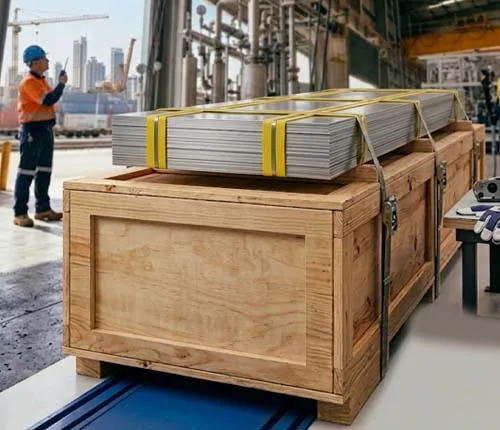 Heavy-duty wooden boxes Packing
We strictly follow seaworthy export handling standards to protect ASTM A387 Gr.11 Plates from transit damage, moisture ingress, and surface contamination during long-distance dispatch.
- Heavy-duty wooden boxes with moisture barrier lining
- HDPE stretch film wrapping on all bundles
- Plastic end caps on threaded and plain-end plate
- Silica gel desiccants to minimize moisture exposure
- ISPM-15 fumigated wooden packaging for export
 Plate Bundle Edge Protection
 Plate Bundle Edge Protection
 Wrapped Export-Ready
Bundles
Wrapped Export-Ready
Bundles
We Export Worldwide
Sachiya Steel International supplies alloy steel products to major industrial markets across North America, Europe, the Middle East, Asia and Africa with export-ready documentation and logistics support.
 USA
USA Canada
 Germany
 UK
UK Italy
Italy France
 Australia
 South Korea
 Indonesia
 Vietnam
 Singapore
 Malaysia
 Taiwan
 UAE
UAE Saudi Arabia
 Qatar
Qatar Oman
Oman
 South Africa
 Nigeria
 Egypt
Egypt