





Carbon Steel Pipe Specifications
Below is the specification range for carbon steel pipes across all grades and forms we carry.
| Specification | Details |
|---|---|
| Standards | ASTM A106, ASTM A53, API 5L, ASTM A333 |
| Grades | A106 Gr. A/B/C, A53 Gr. A/B, API 5L Gr. B to X70 |
| Size Range | 1/2" to 48" NPS (DN 15 to DN 1200) |
| Wall Thickness | SCH 5S, 10, 20, 30, 40 (STD), 60, 80 (XS), 100, 120, 140, 160, XXS |
| Length | 6 m (20 ft), 12 m (40 ft), random, double random, cut-to-size |
| End Type | Plain end, bevelled end, threaded, grooved |
| Surface Finish | Black (mill finish), galvanised, FBE coated, 3LPE coated |
| Form | Seamless, ERW, LSAW/DSAW, HSAW/Spiral |
Size and Schedule Chart
OD and wall thickness values for the most ordered NPS sizes in Schedule 40 and Schedule 80 are listed here.
| NPS (inches) | OD (mm) | SCH 40 Wall (mm) | SCH 80 Wall (mm) |
|---|---|---|---|
| 1/2" | 21.3 | 2.77 | 3.73 |
| 1" | 33.4 | 3.38 | 4.55 |
| 2" | 60.3 | 3.91 | 5.54 |
| 3" | 88.9 | 5.49 | 7.62 |
| 4" | 114.3 | 6.02 | 8.56 |
| 6" | 168.3 | 7.11 | 10.97 |
| 8" | 219.1 | 8.18 | 12.70 |
| 10" | 273.1 | 9.27 | 12.70 |
| 12" | 323.8 | 10.31 | 12.70 |
Carbon Steel Pipe Price
Carbon steel pipe prices begin around fall between ₹80/kg. In other countries, it falls between $0.50 and $5.00 per kg, depending on grade, OD, wall thickness, and order volume. Seamless pipe carries a higher cost than ERW pipe at equivalent dimensions. API 5L X-grades also attract a premium over standard A53 or A106 material. Final pricing depends on specifications, surface finish, quantity, and current steel market conditions. Request a quote for current pricing.
Carbon Steel Pipe Standards and Grades
Several international standards govern CS pipe production. The standard on a purchase order sets the grade options, chemistry limits, and mechanical thresholds.
For high-temperature service up to 400°C, ASTM A106 / ASME SA-106 is the controlling specification. It covers seamless pipe only. Three grades fall under it: Grade A at 48 ksi tensile, Grade B at 60 ksi, and Grade C at 70 ksi. Grade B dominates procurement.
ASTM A53 / ASME SA-53 is the most versatile CS pipe specification because it covers welded (Type E, Type F) and seamless (Type S) manufacturing under one standard. Grade B matches A106 Grade B in tensile and yield, making dual certification possible.
Oil, gas, and water pipelines require API 5L line pipe. The grade ladder starts at Grade B with 35 ksi yield and climbs through X42, X52, X60, X65, to X70 at 70 ksi yield.
Cold-formed structural steel tubing falls under ASTM A500. Grade B provides 58 ksi tensile and 45 ksi yield at minimum. Columns, trusses, and hollow structural sections are the primary use cases.
Low-temperature service down to -45°C calls for ASTM A333 Grade 6. LNG terminals and cold-climate pipelines are typical applications for this specification.
Types of Carbon Steel Pipes
CS pipes come in 5 manufacturing forms:
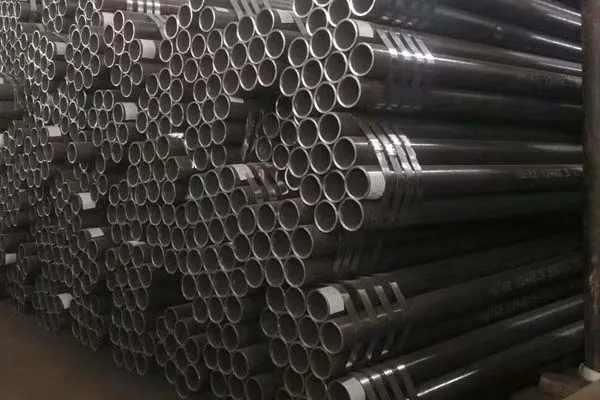
Seamless (SMLS)

ERW (Electric Resistance Welded)

LSAW / DSAW (Longitudinal Submerged Arc Welded)

HSAW / Spiral Welded (Helical Submerged Arc Welded)
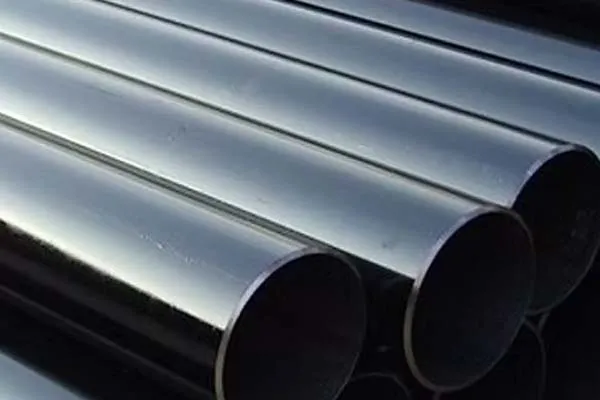
HFW (High Frequency Welded)
Industrial Applications of Carbon Steel Pipes
CS pipes serve 6 major application sectors: oil and gas, structural construction, power generation, water and sewage, fire protection, and chemical processing.
Oil and Gas
API 5L grades carry crude oil, natural gas, and refined products across long-distance pipelines.
Structural Construction
In structural work, CS pipe is the preferred choice for columns, trusses, and load-bearing frames.
Power Generation
Power plants run ASTM A106 Grade B in steam lines and boiler circuits above 300°C.
Water and Sewage
ASTM A53 galvanised pipe handles municipal water and sewage systems.
Fire Protection
Fire protection sprinkler networks also call for A53 pipe with threaded or grooved ends.
Chemical Processing
Where stainless steel isn't cost-justified, chemical plants rely on coated CS pipe for fluid transfer.
Shipping & Packaging
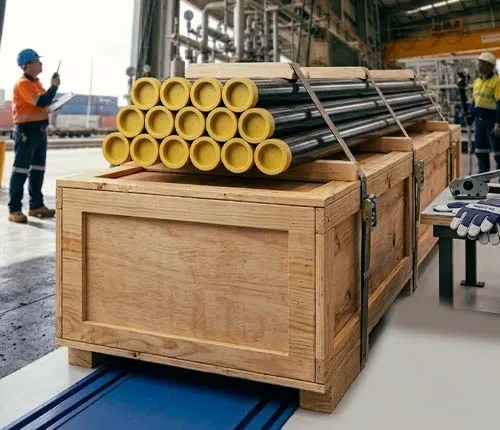 Heavy-duty wooden boxes Packing
We strictly follow seaworthy export handling standards to protect carbon steel pipe from transit damage, moisture ingress, and surface contamination during long-distance dispatch.
- Heavy-duty wooden boxes with moisture barrier lining
- HDPE stretch film wrapping on all bundles
- Plastic end caps on threaded and plain-end pipes
- Silica gel desiccants to minimize moisture exposure
- ISPM-15 fumigated wooden packaging for export
 Pipe Bundle Yard Staging
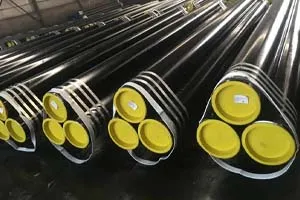 Container End-Cap Protection
 Wrapped Export-Ready Bundles
We Export Worldwide
Sachiya Steel International supplies carbon steel products to major industrial markets across North America, Europe, the Middle East, Asia and Africa with export-ready documentation and logistics support.
 USA
USA Canada
 Germany
 UK
UK Italy
Italy France
 Australia
 South Korea
 Indonesia
 Vietnam
 Singapore
 Malaysia
 Taiwan
 UAE
UAE Saudi Arabia
 Qatar
Qatar Oman
Oman
 South Africa
 Nigeria
 Egypt
Egypt