





Abrasion-Resistant Plate Specifications
The specifications for Abrasion-Resistant Plate, including thickness, length and standards, are listed in the table below.
| Parameter | Details |
|---|---|
| Grades Covered | AR 400, AR 450, AR 500 |
| Thickness Range | 400: 4–130 mm450: 3.2–130 mm500: 3–80 mm |
| Width Range | Up to 3350 mm |
| Length Range | Up to 14630 mm |
| Standards | Typically EN 10029 / EN 10051 |
Available Sizes & Dimensions
| Parameter | Range |
|---|---|
| Thickness | 1 mm to 300 mm |
| Width | 1,000 to 2,500 mm |
| Length | 3,000 to 18,000 mm |
| Hardness Range | 340 to 650 BHN |
| Cut-to-Size | Available on request |
Surface Finish
Surface finishes are available on the following plates
- As-rolled surface finish
- Shot-blasted surface finish
Wear-Resistant Plate Price List
Wear-resistant plate prices range from ₹55 to ₹120 per kg, depending on grade (AR400–AR600) and brand. Approximate equivalent is about $0.70 to $1.50 per kg, with branded plates costing more. Contact us for current rates.
Abrasion-Resistant Plate Grades
Abrasion-resistant plates fall into 3 standard grades by Brinell Hardness: AR400, AR450 and AR500
AR400 (360 to 440 BHN)
AR400 is the most widely used grade for general-purpose wear, balancing hardness, toughness, and weldability. Mining buckets, dump truck liners, and hoppers commonly use it.
AR450 (420 to 500 BHN)
This mid-range grade provides 15 to 20% more abrasion resistance than AR400. Conveyor skirt plates and aggregate handling equipment benefit from AR450.
AR500 (480 to 540 BHN)
Severe abrasion applications require AR500's higher hardness. Preheating to 100 to 200 °C is needed before welding.
Industrial Applications of Wear-Resistant Steel Plates
Wear-resistant plates serve as sacrificial liners across 5 sectors: mining, construction, material handling, OEM fabrication, and process industries.
Mining & Quarrying
AR plates line excavator buckets, haul truck beds, and crusher feed chutes in open-pit and underground mines.
Construction & Earthmoving Equipment
Bulldozer blades, loader edges, and grader mouldboards don't need AR500 hardness; AR400 and AR450 handle soil and gravel.
Material Handling: Chutes, Hoppers & Conveyors
Transfer chutes and conveyor skirt plates use AR liners, lasting 3 to 6 times longer than mild steel.
OEM Fabrication & Custom Wear Parts
OEMs cut AR plates into custom liner segments, wear shoes, and deflector plates.
Cement, Steel & Power Plants
Clinker cooler plates and fan blade protectors use AR500 grade for fine-particle abrasion.
AR400 vs AR500: Which Grade Is Right?
Compare AR400 and AR500 steel plates to select the right grade based on hardness, toughness, weldability, and abrasion resistance.
| Parameter | AR400 Plate | AR500 Plate |
|---|---|---|
| Hardness (BHN) | 360 – 440 | 480 – 540 |
| Abrasion Resistance | Good | Excellent (higher wear life) |
| Toughness | Higher (better impact resistance) | Lower than AR400 |
| Weldability | Better (easier fabrication) | More challenging (requires strict control) |
| Formability | Good | Limited |
| Machinability | Easier | More difficult due to higher hardness |
| Typical Yield Strength | ~1000 MPa | ~1300 MPa |
| Crack Resistance | Better under dynamic loads | Lower compared to AR400 |
| Service Life in High Wear | Moderate | Longer |
| Best Use Case | Structural + wear applications | Extreme abrasion environments |
| Typical Applications | Dump bodies, structural liners, buckets | Ballistic plates, cutting edges, high-wear liners |
Shipping & Packaging
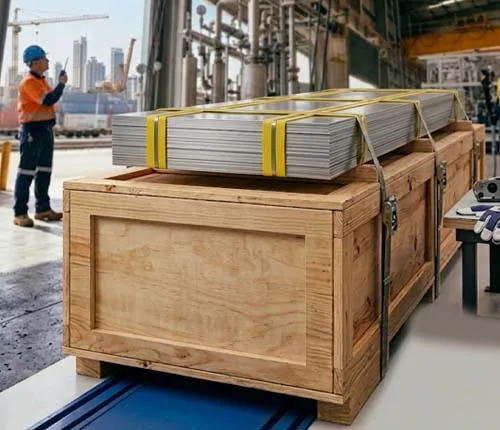 Heavy-duty wooden boxes Packing
We strictly follow seaworthy export handling standards to protect Wear Resistant Plates from transit damage, moisture ingress, and surface contamination during long-distance dispatch.
- Heavy-duty wooden boxes with moisture barrier lining
- HDPE stretch film wrapping on all bundles
- Edge and corner protection with plastic padding
- Silica gel desiccants to minimize moisture exposure
- ISPM-15 fumigated wooden packaging for export
 Plate Bundle Yard
Staging
Plate Bundle Yard
Staging
 Plate Bundle Edge
Protection
Plate Bundle Edge
Protection
 Wrapped Export-Ready
Bundles
Wrapped Export-Ready
Bundles
We Export Worldwide
Sachiya Steel International supplies Wear Resistant products to major industrial markets across North America, Europe, the Middle East, Asia and Africa with export-ready documentation and logistics support.
 USA
USA Canada
 Germany
 UK
UK Italy
Italy France
 Australia
 South Korea
 Indonesia
 Vietnam
 Singapore
 Malaysia
 Taiwan
 UAE
UAE Saudi Arabia
 Qatar
Qatar Oman
Oman
 South Africa
 Nigeria
 Egypt
Egypt