





254 SMO Plate Specifications
SMO 254 plates are high-alloy stainless steel products used for pressure vessels and general industrial applications. They are supplied as plates, sheets, and strips made from chromium- and chromium‑nickel stainless steel, offering high strength and excellent corrosion resistance.
| Property | Details |
|---|---|
| Standard | ASTM A240 / ASME SA-240 |
| Thickness | 4.5 mm to 100 mm |
| Width | 900 mm to 2400 mm |
| Length | 3000 mm to 12000 mm |
| Surface Finish | 2B, 2D, BA, No.4 Satin, 8K Mirror, Hot Rolled |
| Delivery Condition | Annealed & Pickled, Solution Treated |
Size, Weight and Finishes are mentioned below:
Available in a range of sizes, finishes, and forms to suit different project requirements. Key specifications are listed below.
| Specification | Plates |
|---|---|
| Category | Plates |
| Product Type | 254 SMO Plate |
| Thickness | 4.5 mm – 100 mm |
| Width | 900 mm – 2400 mm |
| Length | 3000 mm – 12000 mm |
Forms & Finishes
254 SMO plates are supplied in hot rolled, cold rolled, clad, perforated, and chequered or tread plate forms. Polished finishes include 8K mirror, No.4 satin, BA, 2B, and 2D. Shim sheet, coil, strip, and foil are also available.
254 SMO Plate Price Per Kg
254 SMO plate prices in India are usually between Rs 700 and Rs 900 per kg. The exact rate depends on the plate’s thickness, width, surface finish and the total quantity you order. For international buyers, prices are typically USD 8 to 11 per kg. These rates vary based on the producing mill, shipping terms (FOB, CIF, CFR), and whether you need EN 10204 3.1 or 3.2 certification. Since nickel and molybdenum prices change often, 254 SMO plate prices also vary.
Chemical Composition of 254 SMO Plates
The table below lists the chemical composition of 254 SMO plates (UNS S31254) per ASTM A240 / ASME SA-240.
High molybdenum and nitrogen content set this grade apart from standard 300-series austenitic steels. The low carbon limit of 0.020% max supports weldability and reduces sensitisation risk.
Mechanical Properties of 254 SMO Plates
Below are the mechanical properties of 254 SMO. These plates deliver nearly twice the yield strength of standard austenitic grades like 304 or 316L.
| Property | Value |
|---|---|
| Tensile Strength (min) | 650 MPa (94 ksi) |
| Yield Strength, 0.2% Offset (min) | 300 MPa (44 ksi) |
| Elongation (min) | 35% in 50 mm |
| Density | 8.0 g/cm3 |
Equivalent Designations
The table below shows international equivalent grades for 254 SMO plates. It assists engineers and procurement professionals in aligning material specifications with international standards, ensuring the selection of the most suitable material.
| Standard | Designation |
|---|---|
| UNS | S31254 |
| Germany (DIN) | 1.4547 |
| Europe (EN) | X1CrNiMoCuN20-18-7 |
| Sweden (SS) | 2378 |
| Japan (JIS) | SUS 312L |
| China (GB/T) | 00Cr20Ni18Mo6CuN |
Applications of 254 SMO Plates
6Mo plates perform in high-chloride and aggressive corrosion environments where standard austenitic steels fail. 4 primary sectors drive demand for this grade.
Offshore & Seawater Systems
254 SMO plates are used in seawater cooling circuits, fire-fighting pipework, and offshore platform structures. The PREN above 40 prevents pitting and crevice corrosion in warm, chloride-bearing water.
Chemical & Petrochemical Processing
The alloy handles concentrated sulphuric acid, phosphoric acid, and chloride process streams. Heat exchangers and reactor vessels in chemical plants rely on their corrosion performance.
Pulp & Paper Industry
Bleach plant equipment and chlorine dioxide washers use Alloy 254 plates. Chloride-rich bleaching chemicals attack lower-grade steels that can’t match 254 SMO’s resistance.
Energy & Desalination
Flue gas desulphurisation scrubbers and desalination evaporators operate in acidic condensate conditions. 254 SMO plates resist the combination of high temperature and aggressive chemistry in these systems.
254 SMO Plates vs SS 316 Plates
This comparison shows the main differences between 254 SMO and Stainless Steel 316 plates, so buyers can judge corrosion resistance, strength, and composition and choose the right material for tough industrial conditions.
| Property | 254 SMO (UNS S31254) | SS 316 (UNS S31600) |
|---|---|---|
| Material Type | Super Austenitic Stainless Steel | Austenitic Stainless Steel |
| Chemical Composition (%) | Cr: 19.5–20.5, Ni: 17.5–18.5, Mo: 6.0–6.5, N: 0.18–0.22 | Cr: 16.0–18.0, Ni: 10.0–14.0, Mo: 2.0–3.0, N: 0.10 max |
| PREN (Pitting Resistance Equivalent Number) | > 42 | ~ 25 |
| Tensile Strength (min) | 650 MPa | 515 MPa |
| Yield Strength (min) | ~ 300 MPa | ~ 205 MPa |
254 SMO Plates vs 904L Plates
This comparison covers the key differences between 254 SMO and 904L Stainless Steel plates, helping buyers understand corrosion resistance, alloy composition, and performance in chloride-rich and acidic environments.
| Property | 254 SMO (UNS S31254) | 904L (UNS N08904) |
|---|---|---|
| Material Type | Super Austenitic Stainless Steel | High Alloy Austenitic Stainless Steel |
| Chemical Composition (%) | Cr: 19.5–20.5, Ni: 17.5–18.5, Mo: 6.0–6.5, N: 0.18–0.22, Cu: ≤0.5 | Cr: 19.0–23.0, Ni: 23.0–28.0, Mo: 4.0–5.0, N: ≤0.10, Cu: 1.0–2.0 |
| PREN (Pitting Resistance Equivalent Number) | > 42 | ~ 34 |
| Tensile Strength (min) | 650 MPa | 490 MPa |
| Yield Strength (min) | ~ 300 MPa | ~ 220 MPa |
| Pitting & Crevice Corrosion Resistance | Excellent (Superior in chlorides) | Very Good |
| Chloride Resistance | Outstanding (Seawater grade) | Good |
| Resistance to Reducing Acids | Moderate | Excellent (due to Copper content) |
| Stress Corrosion Cracking Resistance | High | Moderate |
| Cost | High | High (but generally lower than 254 SMO) |
| Typical Applications | Offshore seawater systems, desalination | Acid handling, chemical processing, fertiliser plants |
Shipping & Packaging
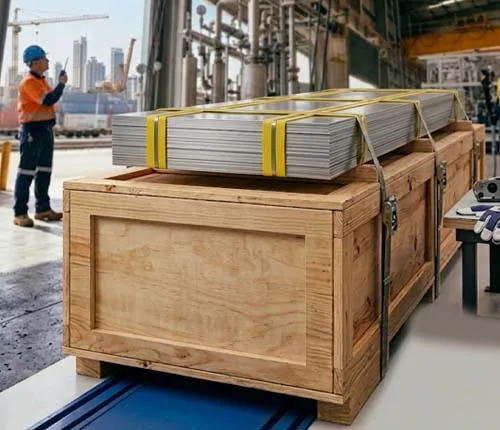 Heavy-duty wooden boxes Packing
We strictly follow seaworthy export handling standards to protect 254 smo plate from transit damage, moisture ingress, and surface contamination during long-distance dispatch.
- Heavy-duty wooden boxes with moisture barrier lining
- HDPE stretch film wrapping on all bundles
- Edge and corner protection with plastic padding
- Silica gel desiccants to minimize moisture exposure
- ISPM-15 fumigated wooden packaging for export
 Plate Bundle Yard
Staging
Plate Bundle Yard
Staging
 Plate Bundle Edge
Protection
Plate Bundle Edge
Protection
 Wrapped Export-Ready
Bundles
Wrapped Export-Ready
Bundles
We Export Worldwide
Sachiya Steel International supplies stainless steel products to major industrial markets across North America, Europe, the Middle East, Asia and Africa with export-ready documentation and logistics support.
 USA
USA Canada
 Germany
 UK
UK Italy
Italy France
 Australia
 South Korea
 Indonesia
 Vietnam
 Singapore
 Malaysia
 Taiwan
 UAE
UAE Saudi Arabia
 Qatar
Qatar Oman
Oman
 South Africa
 Nigeria
 Egypt
Egypt