





Alloy 20 Plate Specifications
The table below lists the specifications of Alloy 20 plates, covering applicable standards, sizes, finishes, and delivery conditions.
| Property | Details |
|---|---|
| Standards | ASTM B463 / ASME SB-463, ASTM A240 / ASME SA-240 |
| Thickness | 1.0 mm to 100 mm |
| Width | Up to 2,500 mm |
| Length | Up to 12,000 mm |
| Surface Finish | Mill Finish, 2B, #4 Polished |
| Form | Hot Rolled, Cold Rolled, Coil-Cut |
| Delivery Condition | Annealed, Solution Treated |
Alloy 20 Plate Sizes
Alloy 20 plates are stocked in a range of standard dimensions. Custom cut-to-size plates can be produced to your project drawings.
Standard Plate Dimensions
We stock plates in the following common ranges:
| Dimension | Range |
|---|---|
| Thickness | 1.0 mm to 100 mm (3/16“ to 4“) |
| Width | Up to 2,500 mm |
| Length | Up to 12,000 mm |
Custom Cut-to-Size Options
Alloy 20 plates are available in custom sizes with precise cutting for flexible, accurate use in many industries.
| Parameter | Details |
|---|---|
| Product | Alloy 20 Plates |
| Custom Sizing | Available as per buyer specification (non-standard widths and lengths) |
| Width Tolerance | -0 / +0.499 inches |
| Length Tolerance | -0 / +0.999 inches |
| Compliance | As per industry standard cutting tolerances |
| Ordering Note | Contact with the required dimensions for quotation |
Alloy 20 Plate Price
Prices are Rs1,800–2,450 per kg in India and $27 to $65 per kg in USD. The final price depends on plate thickness, size, order quantity, surface finish, and current nickel prices. Plates thicker than 50 mm and non-standard widths are priced higher. For the latest quote for your project, please contact our sales team.
Chemical Composition of Alloy 20 Plates
The chemical composition of Alloy 20 (UNS N08020) is listed below. High copper and niobium content separate this alloy from standard austenitic steels.
Mechanical Properties
The mechanical properties of Alloy 20 plates, including tensile strength, elongation and hardness, are listed below.
| Property | Value |
|---|---|
| Tensile Strength (min) | 80 ksi (551 MPa) |
| Yield Strength, 0.2% Offset (min) | 35 ksi (241 MPa) |
| Elongation (min) | 30% |
Equivalent Grades of Alloy 20 Plate
International designations equivalent to Alloy 20 Plates, including UNS and Werkstoff Nr., are listed below:
| Standard | Designation |
|---|---|
| UNS | N08020 |
| EN | 2.4660 |
| Werkstoff Nr. | 2.4660 |
| GB | NS142 |
Alloy 20 Plate Industrial Applications
Alloy 20 plates are used in high-performing industries that require corrosion resistance. The three key industrial sectors are listed below.
Chemical Processing Industry
Alloy 20 plates are used in sulphuric acid piping systems, heat exchangers, and mixing tanks.
Oil & Gas and Petrochemical
Petrochemical plants use Alloy 20 plates in reactor vessels, process piping, and acid storage tanks.
Pharmaceutical and Food Processing
Alloy 20 plates serve pharmaceutical reactor vessels and food processing equipment.
Alloy 20 Plates vs. Alternative Materials
Buyers often compare Alloy 20 plates with 316L stainless steel, SS 904L, and nickel-based alloys. The comparisons below address the most common selection questions.
Alloy 20 Plates vs. 316L Stainless Steel Plates
Differences in nickel content, corrosion resistance, and cost between Alloy 20 and 316L plates help decide which material is more suitable.
| Property / Aspect | Alloy 20 Plates | Stainless Steel 316L Plates |
|---|---|---|
| Nickel Content | 32–38% | 10–14% |
| Resistance to Chloride SCC | Excellent (practically immune) | Moderate (susceptible under conditions) |
| Performance in Sulphuric Acid | Superior (low corrosion rates) | Limited resistance |
| General Corrosion Resistance | High in aggressive chemical environments | Good in mild environments |
| Suitability – Chemical Processing | Highly suitable | Conditionally suitable |
| Suitability – Atmospheric Service | Suitable but over-specified | Highly suitable |
| Cost | Higher | Lower |
| Typical Applications | Acid handling, chemical, pharma | Marine, food, structural, and general use |
| Material Selection Recommendation | Use in highly corrosive environments | Use in general or mild service |
Alloy 20 Plates vs. SS 904L Plates
Alloy 20 and 904L plates differ in stabilisation, molybdenum content, and corrosion resistance, which affects how they perform in welded, acidic, and chloride environments.
| Property / Aspect | Alloy 20 Plates | Stainless Steel 904L Plates |
|---|---|---|
| Sulphuric Acid Resistance | Excellent | Excellent |
| Stabilisation | Niobium stabilised | Not niobium stabilised |
| Intergranular Corrosion (Welded) | Resistant without PWHT | May require control/treatment |
| Post-Weld Heat Treatment (PWHT) | Not required in most cases | May be required depending on the service |
| Molybdenum Content | 2–3% | 4–5% |
| Pitting Resistance (Chlorides) | Good | Superior |
| Weldability | Excellent | Very good |
| Suitability – Acidic Environments | Highly suitable | Highly suitable |
| Suitability – Chloride Environments | Moderate | Excellent |
| Typical Applications | Sulphuric acid service, chemical processing | Marine, offshore, high chloride environments |
| Material Selection Recommendation | Best for sulphuric acid with welding requirements | Best for high chloride and pitting conditions |
Alloy 20 Plates vs. Hastelloy C276 Plates
Alloy 20 and Hastelloy C-276 differ in chemical resistance range and cost, guiding selection for sulphuric acid or aggressive mixed environments.
| Property / Aspect | Alloy 20 Plates | Hastelloy C-276 (Ni-Cr-Mo Alloy) |
|---|---|---|
| Chemical Resistance Range | Good (focused on sulphuric acid environments) | Excellent (broad spectrum, incl. HCl & oxidising media) |
| Hydrochloric Acid Resistance | Limited | Excellent |
| Oxidising Media Resistance | Moderate | Excellent |
| Sulphuric Acid Performance | Excellent | Excellent |
| Cost (Relative) | Lower (approx. half the cost) | High |
| Cost-Effectiveness | High for sulphuric acid-dominant service | Lower unless broad resistance is required |
| Alloy Composition Type | Ni-Fe-Cr with Cu & Nb stabilisation | Ni-Cr-Mo high-performance alloy |
| Typical Applications | Chemical processing, sulphuric acid handling | Severe chemical, petrochemical, and pollution control |
| Material Selection Recommendation | Best for cost-sensitive sulphuric acid use | Best for highly aggressive mixed chemical environments |
Shipping & Packaging
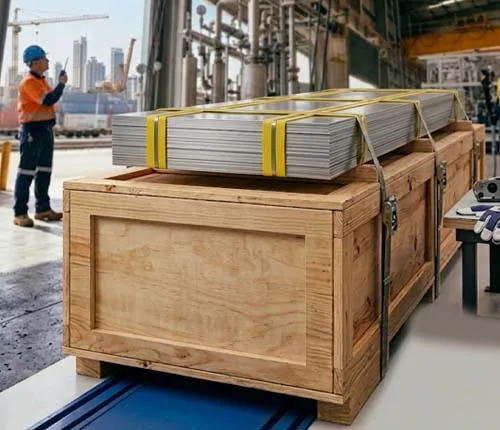 Heavy-duty wooden boxes Packing
We strictly follow seaworthy export handling standards to protect Alloy 20 Plate from transit damage, moisture ingress, and surface contamination during long-distance dispatch.
- Heavy-duty wooden boxes with moisture barrier lining
- HDPE stretch film wrapping on all bundles
- Plastic end caps on threaded and plain-end pipes
- Silica gel desiccants to minimize moisture exposure
- ISPM-15 fumigated wooden packaging for export
 plate Bundle Yard
Staging
plate Bundle Yard
Staging
 Container End-Cap
Protection
Container End-Cap
Protection
 Wrapped Export-Ready
Bundles
Wrapped Export-Ready
Bundles
We Export Worldwide
Sachiya Steel International supplies Alloy steel products to major industrial markets across North America, Europe, the Middle East, Asia and Africa with export-ready documentation and logistics support.
 USA
USA Canada
 Germany
 UK
UK Italy
Italy France
 Australia
 South Korea
 Indonesia
 Vietnam
 Singapore
 Malaysia
 Taiwan
 UAE
UAE Saudi Arabia
 Qatar
Qatar Oman
Oman
 South Africa
 Nigeria
 Egypt
Egypt